29 CFR 1910.1200
Hazard Communication training online
Labels, pictograms, safety data sheets and chemical hazards under OSHA's Hazard Communication Standard, including the 2024 update.
- 9 narrated lessons, about 59 minutes, self-paced
- 20-question test, 80% to pass, unlimited retakes
- Certificate issued on passing, valid 12 months, verifiable online
- For: Any workplace where employees can be exposed to hazardous chemicals: manufacturing, construction, cleaning, labs, auto, healthcare
Lessons
1. The Hazard Communication Standard6 min
2. Your Workplace Program and Your Right to Information7 min
3. Detecting the Presence or Release of Chemicals5 min
4. Physical Hazards, Combustible Dust, and Pyrophoric Gases6 min
5. Health Hazards, Simple Asphyxiants, and Hazards Not Otherwise Classified7 min
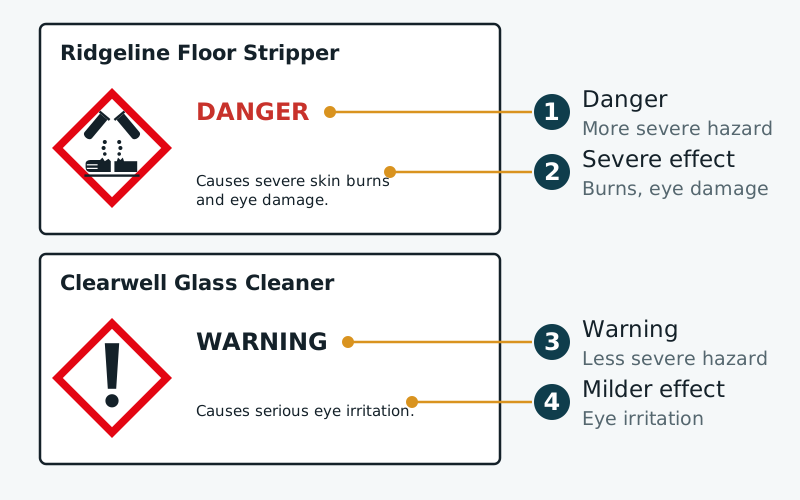
6. Reading Labels: Pictograms, Signal Words, and Statements8 min
7. Workplace Labels and Secondary Containers6 min
8. Safety Data Sheets: The 16 Sections7 min
9. Protecting Yourself: Work Practices, PPE, and Emergencies7 min
What the standard requires, and where it is covered
Each row is a requirement from 29 CFR 1910.1200, in plain English, with the lessons that cover it.
| Citation | Requirement | Covered in |
|---|---|---|
| 1910.1200(h)(1) | Effective information and training at initial assignment and whenever a new chemical hazard is introduced; may be by hazard category or specific chemical; chemical-specific information always available via labels and SDSs. | 1. The Hazard Communication Standard; 9. Protecting Yourself: Work Practices, PPE, and Emergencies |
| 1910.1200(h)(2)(i) | Inform employees of the requirements of the Hazard Communication Standard. | 1. The Hazard Communication Standard; 2. Your Workplace Program and Your Right to Information; 6. Reading Labels: Pictograms, Signal Words, and Statements; 7. Workplace Labels and Secondary Containers; 8. Safety Data Sheets: The 16 Sections |
| 1910.1200(h)(2)(ii) | Inform employees of any operations in their work area where hazardous chemicals are present (general instruction here; employer supplies the site-specific list). | 2. Your Workplace Program and Your Right to Information |
| 1910.1200(h)(2)(iii) | Inform employees of the location and availability of the written program, the list of hazardous chemicals, and SDSs (general instruction here; employer supplies the actual locations). | 2. Your Workplace Program and Your Right to Information; 8. Safety Data Sheets: The 16 Sections; 9. Protecting Yourself: Work Practices, PPE, and Emergencies |
| 1910.1200(h)(3)(i) | Methods and observations to detect the presence or release of a hazardous chemical (employer monitoring, continuous monitors, appearance, odor). | 3. Detecting the Presence or Release of Chemicals |
| 1910.1200(h)(3)(ii) - physical hazards | Physical hazards of chemicals in the work area. | 4. Physical Hazards, Combustible Dust, and Pyrophoric Gases |
| 1910.1200(h)(3)(ii) - health hazards | Health hazards of chemicals in the work area. | 5. Health Hazards, Simple Asphyxiants, and Hazards Not Otherwise Classified |
| 1910.1200(h)(3)(ii) - simple asphyxiation | Simple asphyxiation hazards. | 5. Health Hazards, Simple Asphyxiants, and Hazards Not Otherwise Classified; 3. Detecting the Presence or Release of Chemicals |
| 1910.1200(h)(3)(ii) - combustible dust | Combustible dust hazards. | 4. Physical Hazards, Combustible Dust, and Pyrophoric Gases; 9. Protecting Yourself: Work Practices, PPE, and Emergencies |
| 1910.1200(h)(3)(ii) - pyrophoric gas | Pyrophoric gas hazards. | 4. Physical Hazards, Combustible Dust, and Pyrophoric Gases |
| 1910.1200(h)(3)(ii) - HNOC | Hazards not otherwise classified. | 5. Health Hazards, Simple Asphyxiants, and Hazards Not Otherwise Classified |
| 1910.1200(h)(3)(iii) | Measures employees can take to protect themselves, including the employer's procedures: work practices, emergency procedures, and personal protective equipment. | 9. Protecting Yourself: Work Practices, PPE, and Emergencies; 8. Safety Data Sheets: The 16 Sections |
| 1910.1200(h)(3)(iv) - program details | Details of the employer's hazard communication program. | 2. Your Workplace Program and Your Right to Information |
| 1910.1200(h)(3)(iv) - shipped labels | Explanation of labels received on shipped containers (incl. 2013 label training topics: product identifier, signal word, pictograms, hazard and precautionary statements, supplier info, how elements work together, how to use labels). | 6. Reading Labels: Pictograms, Signal Words, and Statements; 7. Workplace Labels and Secondary Containers |
| 1910.1200(h)(3)(iv) - workplace labeling | The workplace labeling system used by the employer. | 7. Workplace Labels and Secondary Containers |
| 1910.1200(h)(3)(iv) - SDS | The safety data sheet, including the order of information (16 sections) and how employees can obtain and use the appropriate hazard information. | 8. Safety Data Sheets: The 16 Sections; 2. Your Workplace Program and Your Right to Information |
| 1910.1200(j)(2)(ii), (j)(3)(ii) | 2024 update: training on newly identified hazards by Nov 20, 2026 (substances) and May 19, 2028 (mixtures). | 1. The Hazard Communication Standard; 4. Physical Hazards, Combustible Dust, and Pyrophoric Gases; 5. Health Hazards, Simple Asphyxiants, and Hazards Not Otherwise Classified |
Beyond the minimum
- a two-part pictogram quick reference covering all eight required pictograms plus the non-mandatory environment pictogram.
- Secondary-container labeling scenarios applying the immediate-use exemption (1910.1200(f)(8)), with a worked example label.
- A step-by-step SDS walk-through for a product used for the first time, and how to use the SDS in an emergency.
- Trade secret rules (1910.1200(i)), including the 2024 prescribed concentration ranges, emergency disclosure to a treating health care professional, and the written-request and 30-day denial process.
- Employee rights to the written program and SDSs (1910.1200(e)(4), (g)(8)) and anti-retaliation protection under OSH Act Section 11.
- Multi-employer worksite requirements (1910.1200(e)(2)).
- The 2024 update: new hazard classes, small-container and bulk-shipment labeling, DOT pictogram substitution, label and SDS update deadlines, and compliance dates as extended in January 2026.
- Note that OSHA-approved State Plans may add requirements, and how NFPA 704 and HMIS ratings differ from GHS hazard categories.
- Limits of odor as a warning property, and the role of oxygen monitors for simple asphyxiants.
What your employer provides
Employers remain responsible for training on the specific chemicals, written hazard communication program and safety data sheets in their own workplace.
The certificate
Lists your name, the standard, the completion date, the valid through date, and a verification number with a QR code. Page two lists the training elements covered.
Training staff?
Buy seats, invite people by email, and track completion on a dashboard. Buy seats.