29 CFR 1910.132
Personal Protective Equipment training online
When PPE is required, how it is chosen, and how to wear, check and care for eye, face, head, hand, foot, body and hearing protection under OSHA's Subpart I, with an introduction to respirators and fall protection.
- 9 narrated lessons, 40–60 minutes, self-paced
- English or Spanish: lessons, narration, illustrations and test
- 20-question test, 80% to pass, unlimited retakes
- Certificate issued on passing, valid 12 months, verifiable online
- For: Manufacturing, construction, warehouse, maintenance, cleaning, labs and any job where the hazard assessment calls for PPE
Lessons
1. What PPE is and when it is required6 min
2. Hazard assessment and choosing PPE6 min
3. Eye and face protection6 min
4. Head protection6 min
5. Hand and arm protection7 min
6. Foot, leg and body protection7 min
7. Hearing protection7 min
8. Respirators and personal fall protection: what needs more than this course7 min
9. Wearing it right: putting on, taking off, limits, care and retraining7 min
What the standard requires, and where it is covered
Each row is a requirement from 29 CFR 1910.132, in plain English, with the lessons that cover it.
| Citation | Requirement | Covered in |
|---|---|---|
| 1910.132(a) | Protective equipment provided, used, and maintained in a sanitary and reliable condition wherever hazards make it necessary. | 1. What PPE is and when it is required; 6. Foot, leg and body protection; 9. Wearing it right: putting on, taking off, limits, care and retraining |
| 1910.132(b) | Employee-owned equipment: the employer remains responsible for its adequacy, maintenance, and sanitation. | 2. Hazard assessment and choosing PPE |
| 1910.132(d) | Hazard assessment; PPE selection; communicating selection decisions; PPE that properly fits each affected employee; written certification identifying the workplace evaluated, the certifier, and the date(s) (general instruction here; the employer supplies its own assessment results). | 2. Hazard assessment and choosing PPE |
| 1910.132(e) | Defective or damaged PPE shall not be used. | 2. Hazard assessment and choosing PPE; 3. Eye and face protection; 4. Head protection; 5. Hand and arm protection; 9. Wearing it right: putting on, taking off, limits, care and retraining; 6. Foot, leg and body protection |
| 1910.132(f)(1)(i) | Training: when PPE is necessary (general instruction here; the employer identifies the specific tasks and areas). | 1. What PPE is and when it is required; 3. Eye and face protection; 4. Head protection; 5. Hand and arm protection |
| 1910.132(f)(1)(ii) | Training: what PPE is necessary (types of eye and face, head, and hand protection and how they are matched to hazards). | 1. What PPE is and when it is required; 3. Eye and face protection; 4. Head protection; 5. Hand and arm protection |
| 1910.132(f)(1)(iii) | Training: how to properly don, doff, adjust, and wear PPE (general instruction here; the employer supplies hands-on practice with the equipment issued). | 1. What PPE is and when it is required; 2. Hazard assessment and choosing PPE; 3. Eye and face protection; 4. Head protection; 5. Hand and arm protection; 9. Wearing it right: putting on, taking off, limits, care and retraining; 7. Hearing protection |
| 1910.132(f)(1)(iv) | Training: the limitations of the PPE. | 1. What PPE is and when it is required; 3. Eye and face protection; 4. Head protection; 5. Hand and arm protection; 9. Wearing it right: putting on, taking off, limits, care and retraining; 6. Foot, leg and body protection; 7. Hearing protection |
| 1910.132(f)(1)(v) | Training: proper care, maintenance, useful life, and disposal of the PPE. | 1. What PPE is and when it is required; 3. Eye and face protection; 4. Head protection; 5. Hand and arm protection; 9. Wearing it right: putting on, taking off, limits, care and retraining; 6. Foot, leg and body protection; 7. Hearing protection |
| 1910.132(f)(2), (f)(3) | Demonstrating understanding and the ability to use PPE properly before doing the work; retraining triggers (the course test covers understanding; the employer verifies ability to use the actual PPE). | 1. What PPE is and when it is required |
| 1910.132(h) | Payment for PPE: employer pays, with the listed exceptions; replacement PPE; employee-owned PPE. | 2. Hazard assessment and choosing PPE |
| 1910.133 | Eye and face protection: hazards requiring protection, side protection, prescription lenses, manufacturer marking, filter lens shade numbers, and compliance with the listed ANSI Z87.1 editions. | 3. Eye and face protection |
| 1910.135 | Head protection: falling objects, exposed electrical conductors, and compliance with the listed ANSI Z89.1 editions. | 4. Head protection |
| 1910.137 | Electrical protective equipment (awareness level): rubber insulating glove classes and maximum use voltages, protector gloves, inspection and air test before each day's use, and periodic electrical testing. Per 1910.132(g), paragraphs (d) and (f) of 1910.132 do not apply to 1910.137; qualification for electrical work comes from the employer under the electrical standards. | 5. Hand and arm protection |
| 1910.138 | Hand protection: hazards requiring protection, and selection based on the task, conditions present, duration of use, and hazards identified. | 5. Hand and arm protection |
| 1910.132(f)(3) | Retraining when changes in the workplace or in the types of PPE render previous training obsolete, or when inadequacies in an employee's knowledge or use of PPE show the employee has not retained the understanding or skill. | 9. Wearing it right: putting on, taking off, limits, care and retraining |
| 1910.136 | Foot protection: when protective footwear is required (falling or rolling objects, objects piercing the sole, remaining electrical hazards) and the consensus-standard criteria for protective footwear. | 6. Foot, leg and body protection |
| 1910.95(i) (awareness) | Hearing protectors: available at no cost at or above the action level, when they must be worn, choice from a variety, training in use and care, initial fitting and supervision (general instruction here; employer fits and trains on the protectors actually provided). | 7. Hearing protection |
| 1910.95(k) (awareness) | Hearing conservation training topics: effects of noise on hearing; purpose, advantages, disadvantages, attenuation, selection, fitting, use, and care of hearing protectors; purpose and procedures of audiometric testing (general instruction here; the employer's annual program training is still required). | 7. Hearing protection |
| 1910.134 (awareness) | Respiratory protection: written program, medical evaluation, fit testing, user seal checks, facial hair, NIOSH certification, voluntary use and Appendix D. Awareness only; does not satisfy the training required by 1910.134(k). | 8. Respirators and personal fall protection: what needs more than this course |
| 1910.140 (awareness) | Personal fall protection systems: components, anchorage strength, locking connectors, body belt prohibition, free fall limit, inspection, removal from service after impact loading, prompt rescue. Awareness only; does not satisfy the training by a qualified person required by 1910.30. | 8. Respirators and personal fall protection: what needs more than this course |
Beyond the minimum
- The hierarchy of controls, with PPE as the last line of defense, and the Appendix B point that PPE should not be relied on alone.
- Hazard categories, walk-through survey sources, and reassessment from non-mandatory Appendix B to Subpart I.
- How to read ANSI/ISEA Z87.1 markings on eye protection: Z87, Z87+, D3, D4, D5, and W shade numbers.
- Example minimum filter shades from the table in 1910.133(a)(5) and its rule of thumb for choosing a shade.
- Emergency eyewash requirement in 1910.151(c) and knowing where the nearest station is.
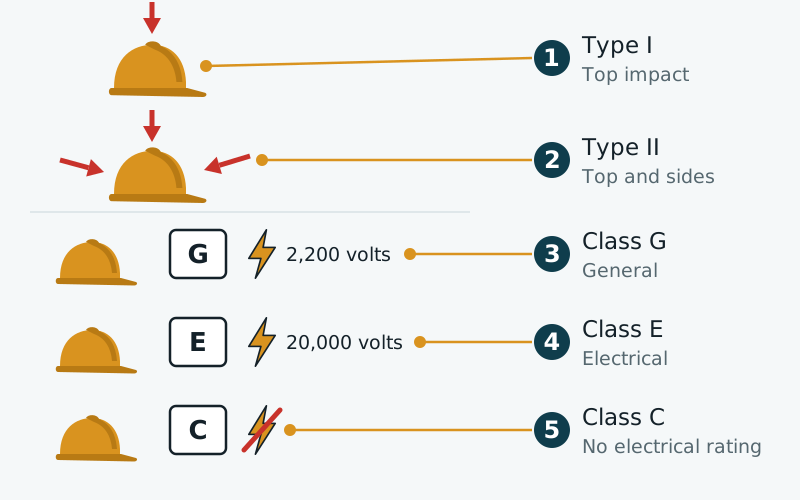
- ANSI/ISEA Z89.1 types and classes, the parts of a hard hat, and how to read the label inside the shell.
- Hard hat care from OSHA guidance: replacement after impact, paint and stickers, storage, wearing a hard hat backwards, and bump caps.
- Chemical glove permeation, breakthrough time, and degradation, and using SDS Section 8 with the glove maker's chart.
- ANSI/ISEA 105 cut levels A1 to A9.
- When not to wear gloves around rotating parts, how to remove contaminated gloves, and latex allergy.
- How to read the ASTM F2413 footwear label and what the codes I, C, Mt, PR, EH, SD and Cd mean.
- Chemical-resistant boots, slip-resistant soles, and signs that footwear is worn out.
- High-visibility clothing and the ANSI/ISEA 107 performance classes, with a note that Subpart I does not name it.
- The hearing conservation program beyond protectors: the 85 and 90 dBA levels, the 5 dB exchange rate, baseline and annual audiograms, and standard threshold shift under 1910.95(c), (g).
- A worked Noise Reduction Rating example using the 7 dB adjustment in 1910.95 Appendix B.
- The NIOSH roll, pull, hold method for foam earplugs and the fit check, plus earmuff seal problems from glasses and hair.
- The raised-voice rule of thumb for recognizing noise that may be above 85 dBA.
- Respirator types, the negative and positive pressure user seal checks from 1910.134 Appendix B-1, and when to leave the area.
- The 4-foot general industry trigger height in 1910.28(b)(1) and fall clearance below the worker.
- Combinations of PPE that must work together, such as cap-mounted earmuffs, face shields over eyewear, and respirator seals.
- A general sequence for removing contaminated PPE and washing afterward.
- Employer payment for replacement PPE under 1910.132(h)(5), the right to file an OSHA complaint, and the 30-day limit for a Section 11(c) retaliation complaint.
What your employer provides
Employers remain responsible for the hazard assessment, for training on the specific PPE they issue, and for verifying that each employee can use it properly under 1910.132(f)(2).
The certificate
Lists your name, the standard, the completion date, the valid through date, and a verification number with a QR code. Page two lists the training elements covered.
Training staff?
Buy seats, invite people by email, and track completion on a dashboard. Buy seats.