29 CFR 1910.146
Permit-Required Confined Spaces training online
How to recognize confined spaces and permit spaces, their atmospheric and physical hazards, the entry permit, air testing, isolation and ventilation, the duties of entrants, attendants and entry supervisors, and rescue under OSHA's 29 CFR 1910.146.
- 9 narrated lessons, 40–60 minutes, self-paced
- English or Spanish: lessons, narration, illustrations and test
- 20-question test, 80% to pass, unlimited retakes
- Certificate issued on passing, valid 12 months, verifiable online
- For: Maintenance, utility, plant, water and wastewater, food processing and contractor crews who enter, attend or supervise entry into tanks, vaults, pits, silos and similar spaces
Lessons
What the standard requires, and where it is covered
Each row is a requirement from 29 CFR 1910.146, in plain English, with the lessons that cover it.
| Citation | Requirement | Covered in |
|---|---|---|
| 1910.146(a) | Scope: general industry; agriculture, construction (29 CFR 1926 Subpart AA), and shipyard employment are excluded. | 1. Confined spaces and permit spaces |
| 1910.146(b) | Definitions: confined space (three-part test), permit-required confined space, non-permit confined space, hazardous atmosphere (10 percent of LFL, combustible dust at or above LFL, oxygen below 19.5 or above 23.5 percent, above a dose or PEL, IDLH), oxygen deficient and enriched, IDLH, engulfment, inerting, isolation, blanking or blinding, double block and bleed, line breaking, entry, entry permit, prohibited condition, emergency, rescue service, and retrieval system. | 1. Confined spaces and permit spaces; 2. Atmospheric hazards; 3. Engulfment, configuration, and physical hazards; 6. Isolation, ventilation, and alternate procedures; 7. Duties of entrants and attendants; 8. Entry supervisors and multi-employer work; 9. Rescue, emergencies, and training |
| 1910.146(c)(1) | The employer evaluates the workplace to determine whether any spaces are permit spaces. | 1. Confined spaces and permit spaces |
| 1910.146(c)(2) | Informing exposed employees of the existence, location, and danger of permit spaces by danger signs (DANGER - PERMIT-REQUIRED CONFINED SPACE, DO NOT ENTER) or other equally effective means. | 1. Confined spaces and permit spaces |
| 1910.146(c)(3) | Where employees will not enter permit spaces, effective measures to prevent entry. | 1. Confined spaces and permit spaces |
| 1910.146(c)(4) | Written permit space program when employees will enter, available for inspection by employees and their representatives. | 4. The permit space program and the entry permit |
| 1910.146(c)(5) | Alternate entry procedures where the only hazard is atmospheric and continuous forced air ventilation alone keeps the space safe: conditions, testing in order with a calibrated direct-reading instrument, ventilation, periodic testing, evacuation, and written certification (awareness level). | 5. Testing and monitoring the atmosphere; 6. Isolation, ventilation, and alternate procedures |
| 1910.146(c)(6) | Reevaluating a non-permit confined space when changes in use or configuration might increase hazards. | 1. Confined spaces and permit spaces; 6. Isolation, ventilation, and alternate procedures |
| 1910.146(c)(7) | Reclassifying a permit space as a non-permit space: no atmospheric hazard, all hazards eliminated (ventilation is control, not elimination), entry to eliminate hazards under the full rules, written certification, and exit and reevaluation if hazards arise (awareness level). | 6. Isolation, ventilation, and alternate procedures |
| 1910.146(c)(8) | Host employer duties to contractors: inform, share hazards and experience, share precautions, coordinate, and debrief. | 8. Entry supervisors and multi-employer work |
| 1910.146(c)(9) | Contractor duties: obtain hazard information, coordinate, and inform the host of the program followed and hazards confronted or created. | 8. Entry supervisors and multi-employer work |
| 1910.146(d)(1), (d)(2) | Program: prevent unauthorized entry; identify and evaluate permit space hazards before entry. | 4. The permit space program and the entry permit |
| 1910.146(d)(3) | Program: safe entry procedures, including acceptable entry conditions, the opportunity to observe testing, isolation, purging, inerting, flushing or ventilating, barriers against external hazards, and verifying conditions throughout the entry. | 3. Engulfment, configuration, and physical hazards; 4. The permit space program and the entry permit; 5. Testing and monitoring the atmosphere; 6. Isolation, ventilation, and alternate procedures |
| 1910.146(d)(4) | Equipment at no cost to employees, maintained and used properly: testing and monitoring, ventilation, communications, PPE, lighting, barriers and shields, ladders, rescue and emergency equipment, and any other equipment needed. | 3. Engulfment, configuration, and physical hazards; 4. The permit space program and the entry permit; 6. Isolation, ventilation, and alternate procedures; 7. Duties of entrants and attendants |
| 1910.146(d)(5) | Evaluating conditions: pre-entry testing, testing or monitoring during entry, continuous monitoring where isolation is infeasible, testing order (oxygen, combustible gases and vapors, toxic gases and vapors), the right to observe testing, reevaluation on request, and immediate results. | 5. Testing and monitoring the atmosphere |
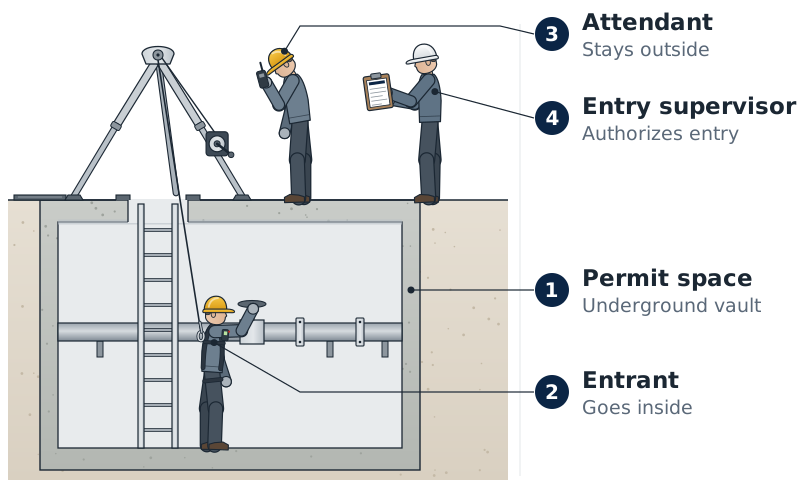
| 1910.146(d)(6), (d)(7) | At least one attendant outside for the duration of entry; procedures when one attendant monitors multiple spaces. | 7. Duties of entrants and attendants |
| 1910.146(d)(8) | Designating entrants, attendants, entry supervisors, and testers, identifying their duties, and training them. | 7. Duties of entrants and attendants |
| 1910.146(d)(9) | Procedures for summoning rescue and emergency services, rescuing entrants, providing emergency services to rescued employees, and preventing unauthorized rescue attempts. | 9. Rescue, emergencies, and training |
| 1910.146(d)(10) | Program: a system for preparing, issuing, using, and canceling entry permits. | 4. The permit space program and the entry permit |
| 1910.146(d)(11) | Coordinating entry operations when employees of more than one employer work in a permit space at the same time. | 8. Entry supervisors and multi-employer work |
| 1910.146(d)(12) | Program: procedures for concluding the entry, such as closing off the space and canceling the permit. | 4. The permit space program and the entry permit |
| 1910.146(d)(13), (d)(14) | Reviewing and revising the program when it may not protect employees, and reviewing canceled permits within 1 year after each entry. | 4. The permit space program and the entry permit; 8. Entry supervisors and multi-employer work |
| 1910.146(e)(1)–(e)(4) | Permit system: documenting pre-entry measures on the permit, signature of the entry supervisor before entry, posting at the entry portal, and duration limited to the time needed for the job. | 4. The permit space program and the entry permit |
| 1910.146(e)(5), (e)(6) | Terminating entry and canceling the permit when the work is done or a prohibited condition arises; noting problems on the permit; keeping canceled permits at least 1 year. | 4. The permit space program and the entry permit; 8. Entry supervisors and multi-employer work |
| 1910.146(f) | Entry permit contents (f)(1)-(f)(15): space, purpose, date and duration, entrants, attendants, entry supervisor and signature, hazards, isolation and control measures, acceptable entry conditions, test results with testers and times, rescue services and how to summon them, communication procedures, equipment, other necessary information, and other permits such as hot work. | 4. The permit space program and the entry permit; 5. Testing and monitoring the atmosphere; 7. Duties of entrants and attendants; 8. Entry supervisors and multi-employer work; 9. Rescue, emergencies, and training |
| 1910.146(g)(1) | Training so that all employees whose work is regulated acquire the understanding, knowledge, and skills for the safe performance of assigned duties (general instruction here; the employer supplies site-specific training and hands-on practice). | 9. Rescue, emergencies, and training |
| 1910.146(g)(2)(i) | Training before the employee is first assigned duties under the section. | 9. Rescue, emergencies, and training |
| 1910.146(g)(2)(ii) | Training before there is a change in assigned duties. | 9. Rescue, emergencies, and training |
| 1910.146(g)(2)(iii) | Training whenever a change in permit space operations presents a hazard the employee has not been trained on. | 9. Rescue, emergencies, and training |
| 1910.146(g)(2)(iv) | Training whenever the employer has reason to believe there are deviations from entry procedures or inadequacies in the employee's knowledge or use of them. | 8. Entry supervisors and multi-employer work; 9. Rescue, emergencies, and training |
| 1910.146(g)(3) | Training establishes proficiency in the duties and introduces new or revised procedures (the course test covers understanding; the employer establishes proficiency with its own spaces and equipment). | 9. Rescue, emergencies, and training |
| 1910.146(g)(4) | Certification of training with each employee's name, the signatures or initials of the trainers, and the dates, available for inspection. | 9. Rescue, emergencies, and training |
| 1910.146(h)(1) | Authorized entrants know the hazards, including the mode, signs or symptoms, and consequences of exposure. | 2. Atmospheric hazards; 7. Duties of entrants and attendants |
| 1910.146(h)(2) | Authorized entrants properly use the equipment required by (d)(4). | 7. Duties of entrants and attendants |
| 1910.146(h)(3) | Authorized entrants communicate with the attendant so the attendant can monitor their status and alert them to evacuate. | 7. Duties of entrants and attendants |
| 1910.146(h)(4) | Authorized entrants alert the attendant on recognizing a warning sign or symptom of exposure or detecting a prohibited condition. | 7. Duties of entrants and attendants |
| 1910.146(h)(5) | Authorized entrants exit as quickly as possible on an evacuation order, a warning sign or symptom, a prohibited condition, or an evacuation alarm. | 5. Testing and monitoring the atmosphere; 7. Duties of entrants and attendants |
| 1910.146(i)(1) | Attendants know the hazards, including the mode, signs or symptoms, and consequences of exposure. | 2. Atmospheric hazards; 7. Duties of entrants and attendants |
| 1910.146(i)(2) | Attendants are aware of possible behavioral effects of hazard exposure in authorized entrants. | 2. Atmospheric hazards; 7. Duties of entrants and attendants |
| 1910.146(i)(3) | Attendants continuously maintain an accurate count of entrants and make sure the means of identifying them is accurate. | 7. Duties of entrants and attendants |
| 1910.146(i)(4) | Attendants remain outside until relieved; entry for rescue only when the program allows it and the attendant is trained, equipped, and relieved. | 7. Duties of entrants and attendants; 9. Rescue, emergencies, and training |
| 1910.146(i)(5) | Attendants communicate with entrants to monitor their status and alert them to evacuate. | 7. Duties of entrants and attendants |
| 1910.146(i)(6) | Attendants monitor activities inside and outside the space and order evacuation for a prohibited condition, behavioral effects, an outside situation that could endanger entrants, or inability to perform all duties. | 3. Engulfment, configuration, and physical hazards; 7. Duties of entrants and attendants |
| 1910.146(i)(7) | Attendants summon rescue and emergency services as soon as entrants may need assistance to escape. | 7. Duties of entrants and attendants; 9. Rescue, emergencies, and training |
| 1910.146(i)(8) | Attendants warn unauthorized persons away, order them out if they enter, and inform entrants and the entry supervisor. | 7. Duties of entrants and attendants |
| 1910.146(i)(9) | Attendants perform non-entry rescues as specified by the employer's rescue procedure. | 7. Duties of entrants and attendants; 9. Rescue, emergencies, and training |
| 1910.146(i)(10) | Attendants perform no duties that might interfere with monitoring and protecting entrants. | 7. Duties of entrants and attendants |
| 1910.146(j)(1) | Entry supervisors know the hazards, including the mode, signs or symptoms, and consequences of exposure. | 2. Atmospheric hazards; 8. Entry supervisors and multi-employer work |
| 1910.146(j)(2) | Entry supervisors verify that the permit's tests, procedures, and equipment are complete and in place before endorsing the permit and allowing entry. | 8. Entry supervisors and multi-employer work |
| 1910.146(j)(3) | Entry supervisors terminate the entry and cancel the permit as required by (e)(5). | 4. The permit space program and the entry permit; 8. Entry supervisors and multi-employer work |
| 1910.146(j)(4) | Entry supervisors verify that rescue services are available and the means for summoning them are operable. | 8. Entry supervisors and multi-employer work |
| 1910.146(j)(5) | Entry supervisors remove unauthorized individuals who enter or attempt to enter. | 8. Entry supervisors and multi-employer work |
| 1910.146(j)(6) | Entry supervisors confirm, at each transfer of responsibility and at intervals dictated by the hazards, that operations remain consistent with the permit and acceptable conditions are maintained. | 8. Entry supervisors and multi-employer work |
| 1910.146(k)(1) | Evaluating and selecting rescue services for timely response and proficiency, informing them of hazards, and giving them access to plan and practice (awareness level). | 9. Rescue, emergencies, and training |
| 1910.146(k)(2) | Employee rescuers: PPE and training at no cost, entrant training, rescue training, first aid and CPR with at least one currently certified member available, and practice at least once every 12 months (awareness level). | 9. Rescue, emergencies, and training |
| 1910.146(k)(3) | Retrieval systems for non-entry rescue: chest or full body harness with the line at the center of the back near shoulder level or above the head, wristlets only where justified, line attached to a mechanical device or fixed point outside, and a mechanical device for vertical spaces more than 5 feet deep. | 9. Rescue, emergencies, and training |
| 1910.146(k)(4) | Safety data sheet (MSDS in the standard's text) or similar written information made available to the medical facility treating an exposed entrant. | 9. Rescue, emergencies, and training |
| 1910.146(l) | Employee participation: employers consult affected employees and their representatives on the program and make the information the section requires available to them. | 4. The permit space program and the entry permit |
Beyond the minimum
- Common locations of confined spaces beyond the standard's examples, such as boilers, ductwork, digesters, and tank cars.
- Normal air at about 20.9 percent oxygen, common causes of oxygen deficiency and enrichment, and why pure oxygen is never used for ventilation.
- A worked example of flammable limits using methane (LFL about 5 percent, UFL about 15 percent) and how meters display percent of LEL.
- Properties of hydrogen sulfide and carbon monoxide, and engine exhaust drawn into a space.
- Bridged material and hidden voids in bins, with a pointer to the grain handling standard, 29 CFR 1910.272.
- Testing stratified atmospheres at the top, middle, and bottom, the 4-foot test zone and minimum response time from non-mandatory Appendix B, and sampling hose delay.
- Bump tests and calibration checks before each day's use from OSHA guidance, calibration per the manufacturer, and the limits of a four-gas meter.
- Why a single closed valve is not isolation, and lockout under the energy control standard, 29 CFR 1910.147.
- Practical forced air ventilation setup: intake location, generators downwind, and duct placement at the work area.
- Communication methods from non-mandatory Appendix C: voice, radio, tapping codes, rope signals, and observing the work.
- Why untrained would-be rescuers become victims, and the Appendix F point that posting a phone number or relying on 911 does not meet (k)(1).
- Construction confined spaces under 29 CFR 1926 Subpart AA, a similar but separate rule.
What your employer provides
Employers remain responsible for training on their own permit spaces, permit procedures and equipment, for hands-on practice that establishes proficiency under 1910.146(g)(3), and for the training certification under (g)(4).
The certificate
Lists your name, the standard, the completion date, the valid through date, and a verification number with a QR code. Page two lists the training elements covered.
Training staff?
Buy seats, invite people by email, and track completion on a dashboard. Buy seats.