29 CFR 1926.503
Fall Protection & Ladders training online
Recognizing fall hazards, guardrails, covers, nets and personal fall arrest systems, roofing work, and choosing, setting up and using ladders and stairways under OSHA's construction standards, Subparts M and X.
- 9 narrated lessons, 40–60 minutes, self-paced
- English or Spanish: lessons, narration, illustrations and test
- 20-question test, 80% to pass, unlimited retakes
- Certificate issued on passing, valid 12 months, verifiable online
- For: Construction, roofing, framing, steel and concrete, remodeling, painting, and anyone who works at heights or uses ladders on a job site
Lessons
What the standard requires, and where it is covered
Each row is a requirement from 29 CFR 1926 Subparts M and X, in plain English, with the lessons that cover it.
| Citation | Requirement | Covered in |
|---|---|---|
| 1926.500(a), (b) | Scope of Subpart M, work covered by other subparts (scaffolds, steel erection, cranes, stairways and ladders), and the definitions used in the subpart. | 1. Falls in construction and your duty to be protected; 2. Recognizing fall hazards in the work area |
| 1926.501(a)(2) | Walking/working surfaces must have the strength and structural integrity to support employees. | 1. Falls in construction and your duty to be protected |
| 1926.501(b)(1) | Unprotected sides and edges 6 feet or more above a lower level: guardrail, safety net, or personal fall arrest system. | 1. Falls in construction and your duty to be protected; 2. Recognizing fall hazards in the work area |
| 1926.501(b)(2) | Leading edges: guardrail, safety net, or personal fall arrest system, or a fall protection plan where those are infeasible or create a greater hazard (awareness here; plans are taught in Roofing work, warning lines, monitors, and fall protection plans). | 2. Recognizing fall hazards in the work area |
| 1926.501(b)(2), (b)(12), (b)(13); 1926.502(k) | Fall protection plans for leading edge, precast concrete, and residential work where conventional protection is infeasible or creates a greater hazard: prepared by a qualified person, site-specific, kept on site, supervised by a competent person, controlled access zones, named employees, investigation after a fall or near miss and plan changes (general instruction here; the employer supplies its own site plan and names the employees). | 6. Roofing work, warning lines, monitors, and fall protection plans |
| 1926.501(b)(3)-(b)(8), (b)(14) | Hoist areas, holes and skylights, formwork and reinforcing steel, ramps and runways, excavations, dangerous equipment, and wall openings. | 2. Recognizing fall hazards in the work area |
| 1926.501(b)(10), (b)(11) | Roofing work on low-slope roofs (guardrail, net, or PFAS; warning line combined with guardrail, net, PFAS, or safety monitor; safety monitor alone on roofs 50 ft or less wide) and protection on steep roofs (guardrails with toeboards, nets, or PFAS); low-slope and steep roof definitions in 1926.500(b). | 6. Roofing work, warning lines, monitors, and fall protection plans |
| 1926.501(c) | Protection from falling objects: hard hats plus toeboards, screens, or guardrails; a canopy; or a barricaded area. | 2. Recognizing fall hazards in the work area |
| 1926.501(c); 1926.502(j) | Protection from falling objects: hard hats plus toeboards, screens, guardrails, canopies, or barricades; toeboard strength and height; no materials within 6 ft of a roof edge without guardrails; stable piles. | 6. Roofing work, warning lines, monitors, and fall protection plans |
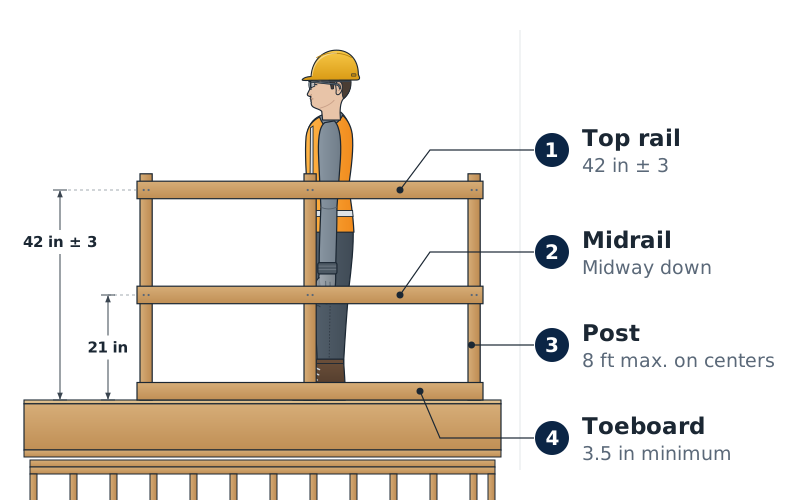
| 1926.502(b), (j) | Guardrail system criteria: top rail height, midrails and screens, strength and deflection, rail size, banding prohibition, wire rope flagging, hoist area and hole guarding; toeboard height and strength. | 3. Guardrails, hole covers, and safety nets; 5. Inspection, rescue, and suspension trauma |
| 1926.502(c) | Safety net systems: placement, outward extension, clearance, drop test, weekly inspection, debris removal, mesh size, and border rope strength. | 3. Guardrails, hole covers, and safety nets |
| 1926.502(d) | Personal fall arrest systems: connectors, locking snaphooks and prohibited connections, lanyards and lifelines, self-retracting lifelines, anchorages, free fall, arresting force and deceleration limits, harness attachment point, no hoisting of materials, removal after impact, prompt rescue, inspection before each use, and no attachment to guardrails or hoists. | 4. Personal fall arrest and positioning systems; 5. Inspection, rescue, and suspension trauma |
| 1926.502(e) | Positioning device systems: 2-foot free fall limit, anchorage strength, connectors and locking snaphooks. | 4. Personal fall arrest and positioning systems |
| 1926.502(f) | Warning line systems: placement 6 ft from the edge, 6 ft and 10 ft with mechanical equipment, access paths, flagging every 6 ft, 34 to 39 in height, 16 lb stanchion test at 30 in, 500 lb line strength, only roofers between the line and the edge, mechanical equipment only where protected. | 6. Roofing work, warning lines, monitors, and fall protection plans |
| 1926.502(g) | Controlled access zones and control lines: 6 to 25 ft from the leading edge, flagged, 39 to 45 in high, connected to a guardrail or wall at each end. | 6. Roofing work, warning lines, monitors, and fall protection plans |
| 1926.502(h) | Safety monitoring systems: competent person, same surface, within sight and speaking distance, no other duties, no mechanical equipment, only roofers or plan-covered employees in the area, prompt compliance with warnings. | 6. Roofing work, warning lines, monitors, and fall protection plans |
| 1926.502(i) | Covers: strength, securing against displacement, and color coding or HOLE/COVER marking. | 3. Guardrails, hole covers, and safety nets |
| 1926.503(a)(1) | A training program that enables each employee to recognize fall hazards and the procedures to minimize them. | 1. Falls in construction and your duty to be protected |
| 1926.503(a)(2)(i) | Training: the nature of fall hazards in the work area (general instruction here; the employer supplies the hazards of its own site). | 1. Falls in construction and your duty to be protected; 2. Recognizing fall hazards in the work area |
| 1926.503(a)(2)(ii) | Training: correct procedures for erecting, maintaining, disassembling, and inspecting the systems used (general instruction here; the employer supplies hands-on, equipment-specific training). | 1. Falls in construction and your duty to be protected; 5. Inspection, rescue, and suspension trauma |
| 1926.503(a)(2)(iii) | Training: use and operation of guardrails, personal fall arrest systems, safety nets, and other protection (warning lines, safety monitoring, and controlled access zones are covered in Roofing work, warning lines, monitors, and fall protection plans; the employer supplies practice with its own equipment). | 3. Guardrails, hole covers, and safety nets; 4. Personal fall arrest and positioning systems |
| 1926.503(a)(2)(iv)-(vii) | Training: each employee's role in safety monitoring systems; limitations on mechanical equipment during low-slope roofing; handling and storage of equipment and materials and erection of overhead protection; the role of employees in fall protection plans (general instruction here; the employer supplies the site's systems and plan). | 6. Roofing work, warning lines, monitors, and fall protection plans |
| 1926.503(a)(2)(viii) | Training: the standards contained in Subpart M. | 1. Falls in construction and your duty to be protected; 2. Recognizing fall hazards in the work area; 3. Guardrails, hole covers, and safety nets; 4. Personal fall arrest and positioning systems; 5. Inspection, rescue, and suspension trauma |
| 1926.503(b) | Written certification record with the employee's name or identity, the training date(s), and the signature of the trainer or employer; date prior training was judged adequate; latest certification kept (the employer prepares and keeps the record). | 9. Stairways, training records, and retraining |
| 1926.503(b), (c) | Written certification of training and retraining triggers (the employer keeps the record and decides when retraining is needed). | 1. Falls in construction and your duty to be protected; 5. Inspection, rescue, and suspension trauma |
| 1926.503(c) | Retraining when changes in the workplace, or in the fall protection systems or equipment used, render previous training obsolete, or when an employee's knowledge or use shows inadequacies. | 9. Stairways, training records, and retraining |
| 1926.1051 | Stairway or ladder required at a break in elevation of 19 in or more without a ramp, runway, embankment, or hoist; points of access kept clear; double-cleat ladder or two ladders for 25 or more employees or two-way traffic; protection installed before work begins. | 7. Choosing and inspecting ladders |
| 1926.1052(a)-(c) | Stairways: landings, 30 to 50 degree angle, uniform risers and treads, no projections, slippery conditions removed, pan and skeleton stairs, temporary treads, handrails and stair rails (4 or more risers or more than 30 in), stair rail and handrail heights, midrails, strength, landing guardrails. | 9. Stairways, training records, and retraining |
| 1926.1053(a) | Ladder construction: load capacity (4 times the maximum intended load; 3.3 for extra-heavy-duty Type 1A metal or plastic), rung spacing and width, slip-resistant metal rungs, no tying ladders together, stepladder spreaders, job-made ladders, fixed ladder cages and safety devices (awareness). | 7. Choosing and inspecting ladders; 8. Setting up and using ladders safely |
| 1926.1053(b)(1)-(b)(11) | Ladder use: 3 ft extension or secured top with a grasping device, no slipping hazards, not over the rated load, designed purpose only, 1 to 4 angle, stable and level surfaces, slippery surfaces, traffic areas, clear top and bottom, top supported equally, not moved while occupied (general instruction here; the employer supplies hands-on practice with the ladders used on site). | 8. Setting up and using ladders safely; 7. Choosing and inspecting ladders |
| 1926.1053(b)(12) | Nonconductive side rails where the employee or the ladder could contact exposed energized electrical equipment (the employer identifies where such equipment is present). | 7. Choosing and inspecting ladders |
| 1926.1053(b)(13)-(b)(22) | Top and top step of stepladders not used as steps; rear cross-bracing not climbed; inspection by a competent person periodically and after occurrences; defective ladders marked or tagged Do Not Use and withdrawn; repairs restore design criteria; no single-rail ladders; face the ladder; at least one hand on the ladder; no loads that cause loss of balance. | 8. Setting up and using ladders safely; 7. Choosing and inspecting ladders |
| 1926.1060(a) | Ladder and stairway training by a competent person: fall hazards in the work area; erecting, maintaining, and disassembling fall protection systems; construction, use, placement, and care of stairways and ladders; maximum intended load-carrying capacities of ladders used; the Subpart X standards (general instruction here; the employer supplies site-specific and hands-on training). | 7. Choosing and inspecting ladders; 8. Setting up and using ladders safely; 9. Stairways, training records, and retraining |
| 1926.1060(b) | Retraining as necessary so each employee maintains the understanding and knowledge acquired. | 9. Stairways, training records, and retraining |
Beyond the minimum
- Fall death statistics: 389 of 1,034 construction deaths in 2024 were falls to a lower level, BLS data cited by OSHA.
- Grouping fall protection by how it works (prevent, arrest, warn or restrict, limit), and why prevention is generally preferred.
- Industry practice of not anchoring to pipes, conduit, or ductwork without a qualified person's approval.
- A site-walk method for finding fall hazards as conditions change day to day.
- Non-mandatory Appendix B guidance on wood guardrail lumber and 8-foot post spacing.
- Why wire rope is flagged and banding is prohibited, and not leaning on or tying off to guardrails.
- How a harness should fit: D-ring between the shoulder blades, chest strap mid-chest, snug leg straps, per manufacturer instructions.
- Worked fall-clearance example: 6 ft lanyard + 3.5 ft deceleration + 1 ft harness stretch + 5 ft D-ring to feet + 2 ft margin = 17.5 ft below the anchor.
- Anchoring at or above the D-ring to keep free fall short.
- Manufacturer inspection points for harness webbing, stitching, hardware, and labels, and impact indicators on absorbers and self-retracting lifelines.
- Suspension trauma and orthostatic intolerance from OSHA SHIB 03-24-2004: warning signs, leg pumping, footholds, and medical evaluation after rescue; relief straps as a manufacturer feature.
- Rescue planning, trained rescuers, and common rescue methods such as aerial lifts, as good practice beyond 502(d)(20).
- Reading slope as rise in 12 with slope triangles on a 9-in-12 and a 2-in-12 roof.
- Why the warning line moves to 10 ft on edges across the direction of mechanical equipment travel, and how unused access paths are closed or offset.
- OSHA's presumption that conventional protection is feasible, and the residential directive STD 03-11-002 that replaced the earlier interim policy.
- Screening when materials are piled higher than a toeboard, 1926.502(j)(4).
- A worked load total (worker, tools, materials) compared with ANSI duty ratings Type IAA through III, labeled as manufacturer/ANSI markings.
- Appendix A to Subpart X: ladders built to the ANSI A14 editions listed there are deemed to meet the 1053(a)(1) strength rule; OSHA's text names only Type 1A, for the 3.3 factor.
- Common improper repairs that do not restore original design criteria.
- A worked 1 to 4 example (16 ft working length, 4 ft base) and FY2025 citation data showing 1926.1053 as OSHA's 3rd most-cited standard.
- Three points of contact taught as industry practice beyond the one-hand rule, plus tool pouches and handlines for raising materials.
- Three common misuses: ladder as a platform, folded stepladder used as a straight ladder, ladder on boxes.
- Wall handrail clearance for temporary handrails and the stair rail used as a handrail at 36 to 37 in.
- Retraining examples for each 1926.503(c) trigger: moving to steep roofs, switching to a self-retracting lifeline, and misuse observed on the job.
What your employer provides
Employers remain responsible for hands-on training by a competent person on the specific fall protection systems and ladders their crews use, and for the written certification record under 1926.503(b).
The certificate
Lists your name, the standard, the completion date, the valid through date, and a verification number with a QR code. Page two lists the training elements covered.
Training staff?
Buy seats, invite people by email, and track completion on a dashboard. Buy seats.