29 CFR 1926.1153
Silica in Construction training online
Health effects of silica dust, the tasks that create it, Table 1 controls, housekeeping, respirators and medical surveillance under OSHA's silica standard for construction.
- 7 narrated lessons, 40–60 minutes, self-paced
- English or Spanish: lessons, narration, illustrations and test
- 20-question test, 80% to pass, unlimited retakes
- Certificate issued on passing, valid 12 months, verifiable online
- For: Concrete, masonry, tile, stone and countertop, demolition, drywall and road crews, and anyone who cuts, grinds, drills or breaks silica-containing materials
Lessons
1. Crystalline silica and the OSHA standard7 min
2. Health effects of silica7 min
3. Tasks that create silica dust7 min
4. Table 1: the specified controls7 min
5. Housekeeping, the exposure control plan and the competent person7 min
6. Respirators and exposure assessment7 min
7. Medical surveillance, records and your rights7 min
What the standard requires, and where it is covered
Each row is a requirement from 29 CFR 1926.1153, in plain English, with the lessons that cover it.
| Citation | Requirement | Covered in |
|---|---|---|
| 1926.1153(a) | Scope: all occupational exposure to respirable crystalline silica in construction work, except where exposure will remain below 25 µg/m³ as an 8-hour TWA under any foreseeable conditions. | 1. Crystalline silica and the OSHA standard |
| 1926.1153(b) | Definitions used in training: action level (25 µg/m³, 8-hour TWA), respirable crystalline silica (quartz, cristobalite, tridymite collected by an ISO 7708 sampler), competent person, and HEPA filter. | 1. Crystalline silica and the OSHA standard; 4. Table 1: the specified controls; 5. Housekeeping, the exposure control plan and the competent person |
| 1926.1153(c)(1), Table 1 | Specified exposure control methods: fully and properly implement the engineering controls, work practices, and respiratory protection listed for each Table 1 task, or follow (d); the Table 1 equipment and task list, with rows (ii), (iii), (vi), (vii), (x), (xi), (xii) and the enclosed-cab rows taught in detail (general instruction here; the employer supplies the specific controls and equipment used on its sites). | 1. Crystalline silica and the OSHA standard; 3. Tasks that create silica dust; 4. Table 1: the specified controls |
| 1926.1153(c)(2) | When implementing Table 1: exhaust as needed indoors or in enclosed areas; water at flow rates sufficient to minimize visible dust for wet methods; enclosed cab or booth requirements (free of settled dust, working door seals and closing mechanisms, gaskets and seals, positive pressure with continuous fresh air, intake filter 95% efficient in the 0.3-10.0 µm range, heating and cooling). | 4. Table 1: the specified controls; 3. Tasks that create silica dust |
| 1926.1153(c)(3) | More than one Table 1 task in a shift: if the combined duration is more than four hours, the respiratory protection for each task is the one specified for more than four hours per shift. | 4. Table 1: the specified controls |
| 1926.1153(d)(1) | Permissible exposure limit of 50 µg/m³ as an 8-hour TWA for tasks not on Table 1 or where Table 1 controls are not fully and properly implemented (overview here; exposure assessment under (d)(2) is covered in lesson 6, Respirators and exposure assessment). | 1. Crystalline silica and the OSHA standard; 4. Table 1: the specified controls |
| 1926.1153(d)(1)–(2) | PEL of 50 µg/m³ for tasks outside Table 1 or where Table 1 is not fully followed; exposure assessment by the performance option or the scheduled monitoring option; repeat monitoring intervals; reassessment; employee notification within 5 working days; observation of monitoring (general instruction here; the employer supplies its own assessment results). | 6. Respirators and exposure assessment |
| 1926.1153(e) | When respiratory protection is required (Table 1, installing controls, controls not feasible, controls not sufficient) and the respiratory protection program under 29 CFR 1910.134. Awareness only; does not satisfy the employer's 1910.134 medical evaluation, fit testing, or training. | 6. Respirators and exposure assessment |
| 1926.1153(e)(3) | Fully and properly implementing Table 1, including its respiratory protection, satisfies (e)(1) and the respirator selection requirements of 1910.134(d)(1)(iii) and (d)(3) for those tasks, taught on the Table 1 overview slide, with the meaning of the minimum APF columns (respirator program details are covered in lesson 6). | 4. Table 1: the specified controls |
| 1926.1153(f) | Housekeeping: no dry sweeping or dry brushing unless wet sweeping, HEPA vacuuming or other low-dust methods are not feasible; no compressed air for clothing or surfaces unless used with a capturing ventilation system or no alternative is feasible. | 5. Housekeeping, the exposure control plan and the competent person |
| 1926.1153(g)(1)–(3) | Written exposure control plan: tasks, controls for each task, housekeeping, procedures to restrict access; annual review; availability to employees (general instruction here; the employer supplies its site plan). | 5. Housekeeping, the exposure control plan and the competent person; 7. Medical surveillance, records and your rights |
| 1926.1153(g)(4) | Designation of a competent person to make frequent and regular inspections of job sites, materials and equipment to implement the plan. | 5. Housekeeping, the exposure control plan and the competent person |
| 1926.1153(h) | Medical surveillance: who is covered, no cost, PLHCP, information the employer gives the PLHCP, initial and periodic exams and their contents, written medical report, limited written opinion, specialist examinations. | 7. Medical surveillance, records and your rights |
| 1926.1153(i)(1) | Hazard communication: silica included in the employer's HazCom program; access to labels and safety data sheets; training under the HCS and (i)(2); cancer, lung effects, immune system effects, and kidney effects addressed (general instruction here; the employer supplies its own program, labels, and SDSs). | 2. Health effects of silica; 7. Medical surveillance, records and your rights |
| 1926.1153(i)(2)(i) | Employer ensures each employee can demonstrate knowledge and understanding of the listed elements (the course test covers the general part; the employer verifies site-specific knowledge). | 7. Medical surveillance, records and your rights |
| 1926.1153(i)(2)(i)(A) | Training: the health hazards associated with exposure to respirable crystalline silica (silicosis in its three forms, lung cancer, COPD, tuberculosis, autoimmune and kidney disease, latency and symptoms). | 2. Health effects of silica |
| 1926.1153(i)(2)(i)(B) | Training: specific tasks in the workplace that could result in exposure (general instruction here on common construction tasks; the employer identifies the specific tasks at its workplace). | 3. Tasks that create silica dust; 1. Crystalline silica and the OSHA standard |
| 1926.1153(i)(2)(i)(C) | Training: specific measures the employer has implemented, including engineering controls, work practices, and respirators (general instruction here on the Table 1 controls and how they must be used; the employer supplies its specific measures and respirators). | 4. Table 1: the specified controls; 1. Crystalline silica and the OSHA standard; 5. Housekeeping, the exposure control plan and the competent person; 6. Respirators and exposure assessment; 7. Medical surveillance, records and your rights |
| 1926.1153(i)(2)(i)(D) | Training: the contents of the section (scope, definitions, PEL and action level, Table 1 and the alternative compliance path, hazard communication here; the remaining paragraphs are covered in lessons 5-7). | 1. Crystalline silica and the OSHA standard; 4. Table 1: the specified controls; 2. Health effects of silica; 5. Housekeeping, the exposure control plan and the competent person; 6. Respirators and exposure assessment; 7. Medical surveillance, records and your rights |
| 1926.1153(i)(2)(i)(E) | Training: the identity of the competent person (this course explains the role and that the employer must identify the person; the employer supplies the name). | 1. Crystalline silica and the OSHA standard; 5. Housekeeping, the exposure control plan and the competent person; 7. Medical surveillance, records and your rights |
| 1926.1153(i)(2)(i)(F) | The purpose and a description of the medical surveillance program required by paragraph (h). | 7. Medical surveillance, records and your rights |
| 1926.1153(i)(2)(ii) | A copy of 1926.1153 readily available without cost to each covered employee (explained here; the employer provides the copy). | 1. Crystalline silica and the OSHA standard; 7. Medical surveillance, records and your rights |
| 1926.1153(j) | Recordkeeping: air monitoring data, objective data and medical surveillance records, maintained and made available under 29 CFR 1910.1020. | 7. Medical surveillance, records and your rights |
Beyond the minimum
- Typical crystalline silica content of granite and engineered stone from the 2026 OSHA/NIOSH Hazard Alert.
- Same-scale size comparison of a sand grain, a human hair, and respirable dust.
- Worked 8-hour TWA example with short peaks above the PEL and an average between the action level and the PEL.
- The PEL in everyday terms: one twenty-thousandth of a dollar bill's weight in one cubic meter of air.
- The three forms of silicosis, their timing, and their course, from non-mandatory Appendix B.
- Smoking and silica together: lung cancer risk greater than additive, and symptoms that can signal tuberculosis or lung cancer.
- Why visible dust is not a measure of exposure, and how personal breathing-zone air sampling works.
- Finding silica on a label and in Section 3 of a safety data sheet.
- OSHA FAQ clarifications: tile saws, demolition hammers with bushing tools, and tasks that usually stay below the action level.
- Bystander and downwind exposure, and dust build-up indoors.
- Worked dust collector airflow calculation: 5-inch wheel times 25 cfm per inch equals 125 cfm.
- Worked combined-task example for the four-hour rule in (c)(3).
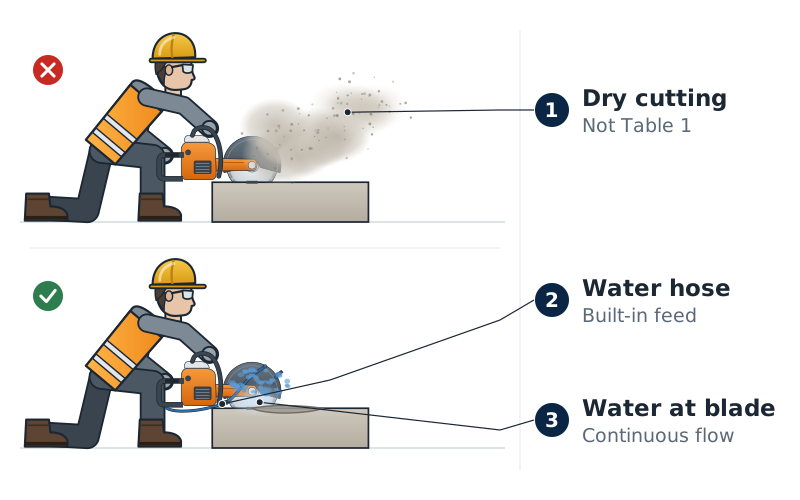
- Common ways Table 1 controls stop being fully and properly used: no water, clogged collector, missing shroud.
- What APF 10 means in practice: a half-mask respirator, including a filtering facepiece, under 1910.134(d)(3).
- Why a shop vacuum without a HEPA filter can blow fine silica out of its exhaust.
- A clothes-cleaning booth with a capture hood and HEPA dust collector as an example of the compressed air exception.
- A worked example of an exposure control plan table, with tasks, controls and Table 1 respirator entries.
- What a competent person checks on a wet-cutting saw: water feed, pump and flow.
- Restricting access in practice: barriers, signs, scheduling and keeping other trades upwind, labeled as common methods.
- Work practice habits labeled as industry practice: standing upwind, checking water flow first, filter maintenance per the manufacturer, and stopping to report a failed control.
- Respirator program awareness from 29 CFR 1910.134: medical evaluation, fit testing and annual training.
- What an assigned protection factor of 10 means, and why N95 or better particulate filters meet 1910.134(d)(3)(iv).
- Facial hair and the facepiece seal, with a close-up of the leak path, and fit changes from weight, dental work or scarring.
- Negative and positive pressure user seal checks from 1910.134 Appendix B-1.
- How a personal air sample is taken: sampler in the breathing zone, tubing and pump.
- Why the latent TB test matters for silica-exposed workers, and what spirometry measures.
- Records retention under 1910.1020 (exposure records 30 years, medical records employment plus 30 years) and the right to see and copy them.
- Section 11(c) protection from retaliation and the 30-day filing period in 29 CFR 1977.15.
- A closing checklist of what the employer provides on site.
What your employer provides
Employers remain responsible for training on the specific tasks, controls, exposure control plan and competent person at their sites under 1926.1153(i)(2)(i)(C) and (E).
The certificate
Lists your name, the standard, the completion date, the valid through date, and a verification number with a QR code. Page two lists the training elements covered.
Training staff?
Buy seats, invite people by email, and track completion on a dashboard. Buy seats.