29 CFR 1926.454
Scaffold Safety training online
Scaffold types and parts, footing, planking and access, fall and falling object protection, power line clearances, load limits and inspections for workers who use scaffolds, under OSHA's Subpart L.
- 7 narrated lessons, 40–60 minutes, self-paced
- English or Spanish: lessons, narration, illustrations and test
- 20-question test, 80% to pass, unlimited retakes
- Certificate issued on passing, valid 12 months, verifiable online
- For: Masons, painters, carpenters, drywall, siding, insulation and maintenance crews, and anyone who works on supported or suspended scaffolds
Lessons
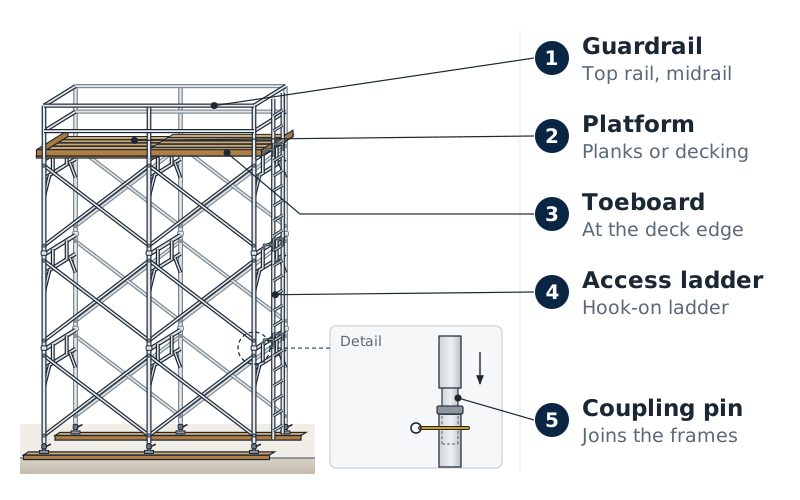
1. What a scaffold is, its parts, and who does what7 min
2. Footing, planking, and access7 min
3. Fall protection on scaffolds7 min
4. Falling object protection6 min
5. Power lines and electrical hazards7 min
6. Loads, materials, and safe use7 min
7. Inspection, damage, and retraining7 min
What the standard requires, and where it is covered
Each row is a requirement from 29 CFR 1926 Subpart L, in plain English, with the lessons that cover it.
| Citation | Requirement | Covered in |
|---|---|---|
| 1926.100(a) | Hard hats where there is a possible danger of head injury from falling objects. | 4. Falling object protection |
| 1926.450(a)-(b) | Scope and definitions: scaffold, supported and suspension scaffolds, scaffold types, competent person, qualified, unstable objects; aerial lifts covered exclusively by 1926.453. | 1. What a scaffold is, its parts, and who does what; 2. Footing, planking, and access |
| 1926.451(a)(1), (a)(3), (a)(4) | Capacity: each scaffold and component supports its own weight and at least 4 times the maximum intended load; suspension ropes at least 6 times the load on them. | 6. Loads, materials, and safe use |
| 1926.451(b)(1)-(b)(7) | Platform construction: fully planked or decked, gaps of 1 inch or less (9½ inches maximum where shown necessary), 18 inch minimum width, 14 inch front edge distance, end extension of 6 to 12 (or 18) inches, overlaps of at least 12 inches over supports. | 2. Footing, planking, and access; 3. Fall protection on scaffolds |
| 1926.451(c)(1)-(c)(3) | Supported scaffolds: restraint against tipping above a 4:1 height-to-base ratio and tie spacing; base plates and mudsills or firm foundation; level, sound, rigid footings; no unstable objects as supports; plumb and braced. | 1. What a scaffold is, its parts, and who does what; 2. Footing, planking, and access |
| 1926.451(e)(1) | Cross braces shall not be used as a means of access. | 7. Inspection, damage, and retraining |
| 1926.451(e)(1)-(e)(2) | Access when platforms are more than 2 feet above or below the point of access; cross braces not used for access; hook-on and attachable ladders with the first rung no more than 24 inches above the supporting level and rest platforms every 35 feet. | 2. Footing, planking, and access |
| 1926.451(f)(1) | Scaffolds and components not loaded in excess of their maximum intended loads or rated capacities, whichever is less. | 6. Loads, materials, and safe use |
| 1926.451(f)(3), (f)(4) | Inspection for visible defects by a competent person before each work shift and after any occurrence that could affect structural integrity; damaged or weakened parts immediately repaired, replaced, braced, or removed from service. | 7. Inspection, damage, and retraining |
| 1926.451(f)(3), (f)(7) | Competent person inspects before each shift and supervises erection, moving, dismantling, and alteration (awareness level; inspection is covered in lesson 7). | 1. What a scaffold is, its parts, and who does what |
| 1926.451(f)(5) | Scaffolds not moved horizontally with employees on them unless designed by a registered professional engineer for such movement or, for mobile scaffolds, 1926.452(w) is followed. | 6. Loads, materials, and safe use |
| 1926.451(f)(6) | Clearance between scaffolds, and conductive material handled on them, and exposed energized power lines, per the voltage table, during erection, use, dismantling, alteration, and moving; exception only after the utility or system operator is notified and de-energizes, relocates, or covers the lines. | 5. Power lines and electrical hazards |
| 1926.451(f)(7) | Scaffolds erected, moved, dismantled, or altered only under the supervision and direction of a competent person, by experienced and trained employees selected by the competent person. | 7. Inspection, damage, and retraining |
| 1926.451(f)(8), (f)(12) | No work on scaffolds covered with snow, ice, or other slippery material except to remove it; no work during storms or high winds unless a competent person determines it is safe and employees are protected by personal fall arrest systems or wind screens, with wind screens only on scaffolds secured against the wind forces. | 6. Loads, materials, and safe use |
| 1926.451(f)(8), (f)(13), (f)(14), (f)(16) | No work on slippery platforms except to clear them; no accumulated debris; no makeshift devices to gain height; deflection of no more than 1/60 of the span. | 2. Footing, planking, and access; 4. Falling object protection |
| 1926.451(f)(9), (f)(13) | Tag lines or equivalent measures for swinging loads that might contact the scaffold; debris not allowed to accumulate on platforms. | 6. Loads, materials, and safe use |
| 1926.451(f)(14), (f)(15) | No makeshift devices such as boxes and barrels, and no ladders, on platforms to increase working height (ladder exception for large area scaffolds noted). | 6. Loads, materials, and safe use |
| 1926.451(f)(16) | Platforms shall not deflect more than 1/60 of the span when loaded. | 6. Loads, materials, and safe use |
| 1926.451(f)(17) | Welding from suspended scaffolds: insulated thimbles, rope insulation at least 4 feet above the hoist, insulated hoist covers, a grounding conductor from scaffold to structure, welder shut off if the grounding lead is disconnected, and no contact by an active rod or uninsulated lead. | 5. Power lines and electrical hazards |
| 1926.451(g)(1) | Fall protection for employees more than 10 feet above a lower level, by scaffold type: guardrails or PFAS on most supported scaffolds; both on single-point and two-point adjustable suspension scaffolds; PFAS on boatswain's chairs and similar scaffolds. | 3. Fall protection on scaffolds |
| 1926.451(g)(2) | Fall protection for erectors and dismantlers where a competent person determines it is feasible and not a greater hazard (awareness level only; the employer trains erectors under 1926.454(b)). | 3. Fall protection on scaffolds |
| 1926.451(g)(3) | PFAS attachment to vertical or horizontal lifelines or structural members; vertical lifelines on independent safe anchorages, with listed items excluded; lifelines and suspension ropes not sharing anchorages. | 3. Fall protection on scaffolds |
| 1926.451(g)(4) | Guardrail systems on all open sides and ends before release for use; top rail heights; midrails; strength of top rails and midrails; cross bracing used as a top rail or midrail. | 3. Fall protection on scaffolds |
| 1926.451(h)(1)-(h)(4) | Falling object protection in addition to hard hats: toeboards, screens, guardrails, debris nets, catch platforms, canopies, barricades; large objects placed away from edges and secured; toeboard height, clearance, openings, and strength. | 4. Falling object protection |
| 1926.452(w) | Mobile scaffolds: casters locked when used in place, manual force applied no more than 5 feet above the surface, and the conditions for riding (surface within 3 degrees of level, height to base 2 to 1 or less, outriggers on both sides, power applied directly to the wheels at no more than 1 foot per second, no one beyond the wheels). | 6. Loads, materials, and safe use |
| 1926.454(a) | Each employee who performs work while on a scaffold is trained by a person qualified in the subject matter to recognize the hazards and the procedures to control or minimize them (general instruction here; the employer supplies training on its own scaffolds, loads, and site hazards). | 1. What a scaffold is, its parts, and who does what |
| 1926.454(a)(1) | Training: the nature of fall and falling object hazards in the work area (electrical hazards are covered in lesson 5). | 3. Fall protection on scaffolds; 4. Falling object protection; 5. Power lines and electrical hazards |
| 1926.454(a)(2) | Training: correct procedures for erecting, maintaining, and disassembling fall protection and falling object protection systems (general instruction here; the employer supplies the procedures for the systems used on site). | 3. Fall protection on scaffolds; 4. Falling object protection; 5. Power lines and electrical hazards |
| 1926.454(a)(3) | Training: proper use of the scaffold and proper handling of materials on it (footing, planking, access, housekeeping, and securing materials here; load handling continues in lesson 6). | 2. Footing, planking, and access; 4. Falling object protection; 6. Loads, materials, and safe use; 7. Inspection, damage, and retraining |
| 1926.454(a)(4) | Training: the maximum intended load and the load-carrying capacities of the scaffolds used (general instruction here; the employer supplies the capacity of each scaffold on its site). | 6. Loads, materials, and safe use |
| 1926.454(a)(5) | Training: any other pertinent requirements of Subpart L (inspection, damaged components, alterations, weather, access; the employer adds requirements specific to its scaffolds). | 6. Loads, materials, and safe use; 7. Inspection, damage, and retraining |
| 1926.454(b) | Awareness only: employees who erect, disassemble, move, operate, repair, maintain, or inspect scaffolds must be trained by a competent person; this course does not satisfy that training. | 7. Inspection, damage, and retraining |
| 1926.454(c) | Retraining when worksite changes, changes in scaffolds, fall protection, falling object protection, or other equipment, or inadequacies in an employee's work show a need for it. | 7. Inspection, damage, and retraining |
Beyond the minimum
- Identifying the parts of a frame scaffold, including screw jacks and coupling pins, so users can spot a missing or damaged part.
- The four common supported scaffold types and the difference between scaffolds and aerial lifts.
- Who the competent person and qualified person are on a site and how to find them.
- Screw jack extension limits as a manufacturer instruction and why a jack cranked far out is a warning sign.
- Why planks that overhang too far can tip like a seesaw.
- A worked 1/60 deflection example for a 7 foot span.
- A worked 4:1 example for a 5 foot base, with the 20 and 26 foot vertical tie spacing.
- The 10 foot scaffold trigger compared with the 6 foot trigger in Subpart M.
- Why a guardrail is not a fall arrest anchorage: 200 pound rail strength compared with the 5,000 pound anchorage requirement in 1926.502(d)(15).
- The 14 inch front edge rule for platforms next to the face of the work.
- Tool tethering as an industry practice under ANSI/ISEA 121-2018, labeled as not an OSHA rule.
- Clearing the deck at the end of each shift so wind cannot blow loose materials off.
- Worked example of the over-50 kV clearance calculation for a 115 kV line, and using insulator length as a visible clue to higher voltage.
- Treating every overhead line as energized and calling the utility before setting up near lines, labeled as industry practice.
- Checking the whole route overhead and using a spotter before moving a mobile scaffold near lines.
- Light, medium, and heavy duty ratings of 25, 50, and 75 pounds per square foot from non-mandatory Appendix A.
- Point loads versus distributed loads, and what the 1/60 deflection limit means on a 7-foot span.
- Why wind screens and tarps increase wind load and must not be added by users.
- Green, yellow, and red scaffold tag systems, labeled as industry practice rather than an OSHA requirement.
- A user's daily pre-use check of guardrails, planks, access, and base, and how to report problems.
- Common kinds of component damage: bent legs, split planks, and braces off their locks.
What your employer provides
Employers remain responsible for training by a qualified person on the specific scaffolds at their sites, and for separate erector and dismantler training under 1926.454(b).
The certificate
Lists your name, the standard, the completion date, the valid through date, and a verification number with a QR code. Page two lists the training elements covered.
Training staff?
Buy seats, invite people by email, and track completion on a dashboard. Buy seats.