Annual in-service training
Client Rights and Abuse Prevention training online
A one-hour annual in-service for caregivers: client rights at home, recognizing abuse, neglect, self-neglect and financial exploitation, money and professional boundaries, how to report, and handling difficult situations without force or restraints.
- 5 narrated lessons, 1 hour, self-paced
- Complete the course at your pace; your progress saves automatically
- English or Spanish: lessons, narration, illustrations and test
- 15-question test, 80% to pass, unlimited retakes
- Certificate issued on passing, valid 12 months, verifiable online
- For: Home care aides, personal care aides, home health aides and CNAs working in clients' homes and small facilities
Lessons
What the rules require, and where it is covered
Each row is a requirement from state annual training-hour rules for home care aides and federal in-service rules for aides, in plain English, with the lessons that cover it.
| Citation | Requirement | Covered in |
|---|---|---|
| 42 CFR 483.5 | Definitions of abuse (including unreasonable confinement and abuse facilitated by technology), sexual abuse, neglect, exploitation, mistreatment and misappropriation of resident property. Reviewed with examples from home and facility settings. | 2. Recognizing abuse, neglect and exploitation; 3. Financial exploitation and professional boundaries |
| 42 CFR 483.12 | Freedom from abuse, neglect, misappropriation of resident property and exploitation, including corporal punishment and involuntary seclusion; reporting alleged violations within 2 hours (abuse or serious bodily injury) or 24 hours, and preventing further harm during investigation (483.12(c)(1)-(4)). Reviewed with signs, the reporting route and time limits (general instruction here; the employer supplies its own procedures). | 2. Recognizing abuse, neglect and exploitation; 4. What to do and how to report |
| 42 CFR 483.12(a)(2) | Freedom from physical or chemical restraints imposed for discipline or convenience and not required to treat medical symptoms. Reviewed with examples of physical and chemical restraints that aides do not use. | 5. Prevention and difficult situations |
| 42 CFR 483.12(b)(5) | Facility policies ensure reporting of crimes under section 1150B of the Social Security Act. Reviewed with covered individuals and time limits. | 4. What to do and how to report |
| 42 CFR 483.95(c) | Facility training on what constitutes abuse, neglect, exploitation and misappropriation, procedures for reporting, and dementia management and abuse prevention. This module covers the definitions, reporting and prevention; the facility supplies its own procedures. | 2. Recognizing abuse, neglect and exploitation; 3. Financial exploitation and professional boundaries; 4. What to do and how to report; 5. Prevention and difficult situations |
| 42 CFR 483.95(g)(2) | Nurse aide in-service training must include resident abuse prevention. This module covers abuse prevention; the facility sets total hours. | 2. Recognizing abuse, neglect and exploitation; 3. Financial exploitation and professional boundaries; 4. What to do and how to report; 5. Prevention and difficult situations |
| 42 CFR 484.50(a)(1) | Written notice of patient rights before care begins, at the initial evaluation visit, with the administrator's complaint contact. | 1. Client rights in home and community care |
| 42 CFR 484.50(b) | Exercise of rights by a court-appointed or other legal representative to the extent allowed. Reviewed with how the supervisor identifies the representative. | 1. Client rights in home and community care |
| 42 CFR 484.50(c) | Patient rights: respect for person and property; freedom from verbal, mental, sexual and physical abuse, injuries of unknown source, neglect and misappropriation; complaints; participation, consent and refusal; confidentiality of the clinical record; the state hotline; freedom from discrimination or reprisal. | 1. Client rights in home and community care; 2. Recognizing abuse, neglect and exploitation; 4. What to do and how to report |
| 42 CFR 484.50(e) | Agency investigation and documentation of complaints and prevention of retaliation (e)(1); immediate reporting by any staff member who notices mistreatment, neglect, abuse or misappropriation, to the agency and other appropriate authorities in accordance with state law (e)(2). | 1. Client rights in home and community care; 4. What to do and how to report |
| 42 CFR 484.80(b)(3), (d) | Home health aide training subjects including respect for the patient's privacy and property and observing, reporting and documenting; at least 12 hours of in-service training in each 12-month period. This module provides 1 hour toward that total. | 1. Client rights in home and community care; 2. Recognizing abuse, neglect and exploitation; 3. Financial exploitation and professional boundaries; 4. What to do and how to report; 5. Prevention and difficult situations |
| CA HSC 1796.44(c)(1) clients' rights and safety | Annual training for home care aides on clients' rights and safety. Reviewed with dignity, privacy, choice, refusal, confidentiality, property, complaints and safe responses to aggression. | 1. Client rights in home and community care; 5. Prevention and difficult situations |
| CA HSC 1796.44(c)(3) abuse and neglect | Annual training on how to report, prevent and detect abuse and neglect. Reviewed with types and signs of abuse, neglect, self-neglect and financial exploitation, the reporting route and prevention (general instruction here; the employer supplies its own procedures). | 2. Recognizing abuse, neglect and exploitation; 3. Financial exploitation and professional boundaries; 4. What to do and how to report; 5. Prevention and difficult situations |
| 42 U.S.C. 1320b-25 (SSA section 1150B) | Covered individuals in long-term care facilities receiving at least $10,000 in federal funds report reasonable suspicion of a crime to the state survey agency and law enforcement within 2 hours (serious bodily injury) or 24 hours; no retaliation against employees who report (subsection (d)). | 4. What to do and how to report |
| 42 U.S.C. 1397j (Elder Justice Act) | Definitions of abuse, caregiver, exploitation, fiduciary, neglect and self-neglect. Reviewed with self-neglect, fiduciaries and financial exploitation. | 2. Recognizing abuse, neglect and exploitation; 3. Financial exploitation and professional boundaries |
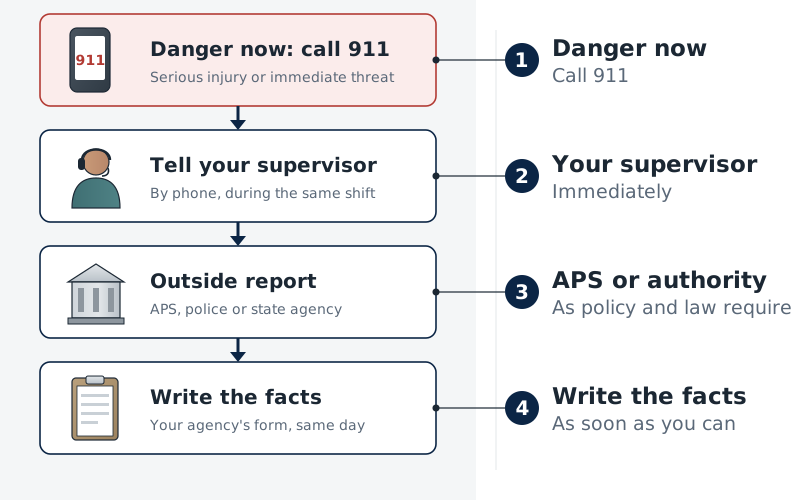
| ACL and National Center on Elder Abuse | 911 for immediate danger; Adult Protective Services in every state, who it serves, voluntary services and the right to decline, mandated reporters by state, anonymous reports, good-faith protections; Eldercare Locator. | 4. What to do and how to report |
| CDC abuse of older persons | Types of abuse, prevalence among older adults living at home, and risk factors for perpetration, including caregiver stress, inadequate training, isolation, dependence and facility staffing problems. | 2. Recognizing abuse, neglect and exploitation; 5. Prevention and difficult situations |
| FTC and DOJ Elder Justice Initiative | Four signs of a scam and payment methods scammers demand; National Elder Fraud Hotline. | 3. Financial exploitation and professional boundaries |
| National Institute on Aging | Types and signs of elder abuse, abandonment, and watching for patterns. | 2. Recognizing abuse, neglect and exploitation |
Beyond the minimum
- A refused-shower scenario and how to respond to refusals without force, tricks or rewards.
- A two-week visit-log example showing how separate signs form a reportable pattern.
- Gifts, cash, rings and a client's debit card with PIN; a client adding the aide to her bank account.
- A grocery-run money log: amount received, receipt, change returned and client initials.
- A grandparent scam demanding gift cards, and the FTC's four signs of a scam.
- Responding to a disclosure of abuse without promising secrecy or investigating.
- Positioning and words for an angry or aggressive client, and when to leave and call 911.
- A coworker handling a client roughly at shift change, and reporting your own mistakes.
What your employer provides
Employers remain responsible for training on their own policies and care plans and for keeping each caregiver's annual training-hour record.
The certificate
Lists your name, the standard, the completion date, the retrain by date, and a verification number with a QR code. Page two lists the training elements covered.
Training staff?
Buy seats, invite people by email, and track completion on a dashboard. Buy seats.