Annual in-service training
Dementia Care Basics training online
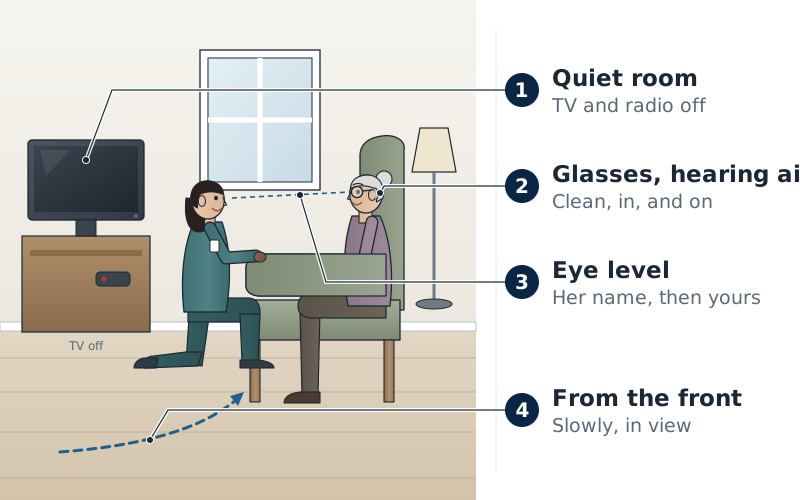
A one-hour annual in-service on what dementia is, communicating with a person who has dementia, responding to behaviors, daily care and home safety, and the rights and abuse risks of people living with dementia.
- 5 narrated lessons, 1 hour, self-paced
- Complete the course at your pace; your progress saves automatically
- English or Spanish: lessons, narration, illustrations and test
- 15-question test, 80% to pass, unlimited retakes
- Certificate issued on passing, valid 12 months, verifiable online
- For: Home care aides, personal care aides, home health aides and CNAs who care for clients living with dementia in homes and small facilities
Lessons
What the rules require, and where it is covered
Each row is a requirement from state annual training-hour rules for home care aides and federal in-service rules for aides, in plain English, with the lessons that cover it.
| Citation | Requirement | Covered in |
|---|---|---|
| 42 CFR 483.5 | Definitions of abuse (including unreasonable confinement), neglect, exploitation and misappropriation of resident property. Reviewed with why people with dementia are at higher risk. | 5. Rights, dignity and abuse risk |
| 42 CFR 483.10(e)(1) | Right to be free from physical or chemical restraints imposed for discipline or convenience and not required to treat medical symptoms. Reviewed with examples of physical and chemical restraints and the calm alternatives in Lesson 3. | 3. Responding to behaviors; 5. Rights, dignity and abuse risk |
| 42 CFR 483.12 | Freedom from abuse, neglect, misappropriation of resident property and exploitation, including restraints (483.12(a)(2)). Reviewed with signs to notice and how to report (general instruction here; the employer supplies its own procedures). | 5. Rights, dignity and abuse risk |
| 42 CFR 483.95(g)(2) | Nurse aide in-service training must include dementia management and resident abuse prevention. This module covers both; the facility sets total hours and its own procedures. | 1. What dementia is; 2. Communicating with a person who has dementia; 3. Responding to behaviors; 4. Daily care and safety; 5. Rights, dignity and abuse risk |
| 42 CFR 484.50(c)(2) | Home health patients' right to be free from verbal, mental, sexual and physical abuse, injuries of unknown source, neglect and misappropriation of property. | 5. Rights, dignity and abuse risk |
| 42 CFR 484.50(e)(2) | Home health agency staff who notice possible abuse, neglect or misappropriation must report it immediately to the agency and other appropriate authorities in accordance with state law. | 5. Rights, dignity and abuse risk |
| 42 CFR 484.80(d) | Home health aide in-service training of at least 12 hours in each 12-month period. This module provides 1 hour toward that total on dementia care and abuse prevention. | 1. What dementia is; 2. Communicating with a person who has dementia; 3. Responding to behaviors; 4. Daily care and safety; 5. Rights, dignity and abuse risk |
| CA HSC 1796.44(c)(1) clients' rights and safety | Annual training for home care aides on clients' rights and safety. Reviewed with dignity, choice, refusal of care, restraints and home safety. | 4. Daily care and safety; 5. Rights, dignity and abuse risk |
| CA HSC 1796.44(c)(2) daily living needs | Annual training on providing for and responding to clients' daily living needs. Reviewed with routines, bathing, dressing, toileting, eating and swallowing. | 4. Daily care and safety |
| CA HSC 1796.44(c)(3) abuse and neglect | Annual training on how to report, prevent and detect abuse and neglect. Reviewed with signs of abuse, neglect and financial exploitation and the reporting route (general instruction here; the employer supplies its own procedures). | 5. Rights, dignity and abuse risk |
| CA HSC 1796.44(c)(4) personal hygiene and home care services | Annual training on assisting with personal hygiene and other home care services. Reviewed with bathing, dressing and toileting for clients with dementia. | 4. Daily care and safety |
| CA SB 412 (Stats. 2025, ch. 414) | Beginning January 1, 2027, home care aides complete training on the special care needs of clients with dementia before providing care and annually thereafter. This module covers dementia types, communication, behaviors, daily care, safety and abuse risk. | 1. What dementia is; 2. Communicating with a person who has dementia; 3. Responding to behaviors; 4. Daily care and safety; 5. Rights, dignity and abuse risk |
| 42 U.S.C. 1397j (Elder Justice Act) | Definitions of abuse, neglect and exploitation of elders, and Adult Protective Services, reviewed in summary with the role of APS programs funded through the Administration for Community Living. | 5. Rights, dignity and abuse risk |
| CDC STEADI | Home fall hazards and fixes: clear walkways, loose rugs, cords, lighting, night lights, grab bars and handrails. | 4. Daily care and safety |
| National Institute on Aging | Dementia types and stages, delirium and reversible causes of confusion, communication techniques, sundowning, wandering prevention, and bathing, dressing and eating guidance for Alzheimer's caregivers. | 1. What dementia is; 2. Communicating with a person who has dementia; 3. Responding to behaviors; 4. Daily care and safety |
Beyond the minimum
- Delirium compared with dementia, and a same-shift report for sudden confusion.
- Scenarios: a client asking for a spouse who has died, and a client asking to pick up children who are now adults.
- Scenarios: afternoon agitation from a toileting need, a morning exit attempt to a former job, and an accusation of theft.
- A missing-client sequence: quick search per agency protocol, a prompt 911 call stating the person has dementia, then the supervisor.
- A financial exploitation scenario involving a relative and the client's checks.
- Writing objective visit notes: facts, the client's own words, actions taken and who was told.
What your employer provides
Employers remain responsible for training on their own policies and care plans and for keeping each caregiver's annual training-hour record.
The certificate
Lists your name, the standard, the completion date, the retrain by date, and a verification number with a QR code. Page two lists the training elements covered.
Training staff?
Buy seats, invite people by email, and track completion on a dashboard. Buy seats.