Annual in-service training
Falls and Emergencies training online
A one-hour annual in-service for caregivers on why older adults fall, making a home safer, safe mobility assistance within an aide's role, what to do when a fall happens, and responding to stroke, heart attack, choking, fire, severe weather and power outages.
- 5 narrated lessons, 1 hour, self-paced
- Complete the course at your pace; your progress saves automatically
- English or Spanish: lessons, narration, illustrations and test
- 15-question test, 80% to pass, unlimited retakes
- Certificate issued on passing, valid 12 months, verifiable online
- For: Home care aides, personal care aides, home health aides and CNAs working in clients' homes and small facilities
Lessons
What the rules require, and where it is covered
Each row is a requirement from state annual training-hour rules for home care aides and federal in-service rules for aides, in plain English, with the lessons that cover it.
| Citation | Requirement | Covered in |
|---|---|---|
| 42 CFR 483.95(g) | Nurse aide in-service training of no less than 12 hours per year, sufficient to ensure continuing competence. This module provides 1 hour toward that total on fall prevention, safe mobility and emergencies; the facility sets its own procedures. | 1. Why falls matter and who is at risk; 2. Making the home safer; 3. Safe mobility assistance within your role; 4. When a fall happens; 5. Other emergencies in the home |
| 42 CFR 484.80(b)(3)(vi) | Home health aide training subject: maintenance of a clean, safe and healthy environment. Reviewed with home fall hazards, lighting, bathrooms, stairs, walking aids and footwear. | 2. Making the home safer |
| 42 CFR 484.80(b)(3)(vii) | Home health aide training subject: recognizing emergencies and instituting emergency procedures. Reviewed with falls, calling 911, stroke, heart attack, choking, fire, severe weather and power outages (general instruction here; CPR, AED use and choking first aid technique are not taught). | 4. When a fall happens; 5. Other emergencies in the home |
| 42 CFR 484.80(d) | Home health aide in-service training of at least 12 hours in each 12-month period. This module provides 1 hour toward that total. | 1. Why falls matter and who is at risk; 2. Making the home safer; 3. Safe mobility assistance within your role; 4. When a fall happens; 5. Other emergencies in the home |
| 42 CFR 484.80(g) | Home health aide duties include assistance in ambulation and services in the plan of care, and aides report changes in the patient's condition. Reviewed with levels of assistance, standby assist, gait belts and reporting new unsteadiness, dizziness and falls. | 1. Why falls matter and who is at risk; 3. Safe mobility assistance within your role; 4. When a fall happens |
| 42 CFR 484.102 | Home health agency emergency preparedness program, including an individual emergency plan for each patient and follow-up with staff and patients when services are interrupted. Reviewed with the aide's part: knowing the client's plan, emergency information and contacts, and the agency's check-in procedure (general instruction here; the employer supplies its own plan). | 5. Other emergencies in the home |
| CA HSC 1796.44(c)(1) clients' rights and safety | Annual training for home care aides on clients' rights and safety. Reviewed with the client's right to arrange her home and refuse changes, home fall hazards, safe mobility within the care plan, falls and emergencies. | 2. Making the home safer; 3. Safe mobility assistance within your role; 4. When a fall happens; 5. Other emergencies in the home |
| CA HSC 1796.44(c)(2) daily living needs | Annual training on providing for and responding to clients' daily living needs. Reviewed with walking, transfers, toileting at night, bathing safety and walking aids. | 2. Making the home safer; 3. Safe mobility assistance within your role |
| 911.gov; Ready.gov; USFA FA-221 | What to tell a 911 call-taker; home fire escape and not re-entering; fire safety for older adults and medical oxygen; power outages, medical devices, refrigerated medicines, generators and carbon monoxide. | 5. Other emergencies in the home |
| CDC and American Stroke Association | Stroke signs (B.E. F.A.S.T. and F.A.S.T.), noting the time symptoms started, calling 911 even if symptoms go away; heart attack warning signs, including those more common in women. | 5. Other emergencies in the home |
| CDC Older Adult Falls Data | Falls among adults 65 and older: more than 1 in 4 fall each year, about 4.5 million emergency department visits, over 43,000 deaths in 2024, hip fractures and traumatic brain injury, and blood thinners and bleeding in the brain after a head injury. | 1. Why falls matter and who is at risk; 4. When a fall happens |
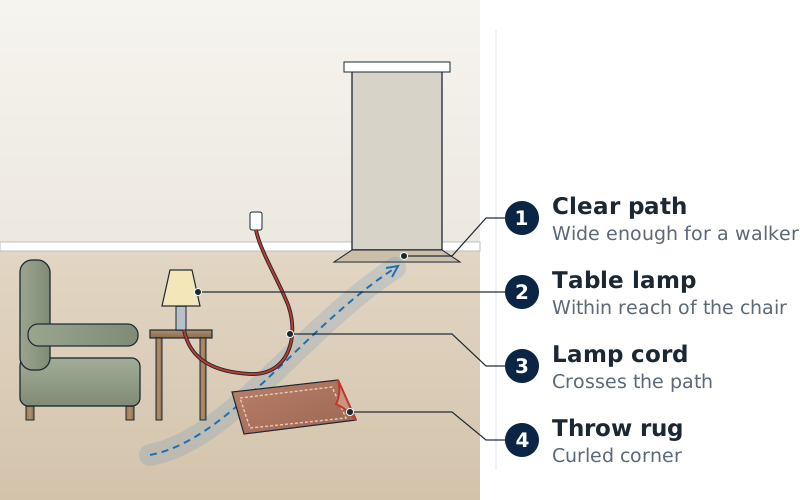
| CDC STEADI | Older adult fall risk factors (intrinsic and extrinsic, including fear of falling and assistive device use) and the Check for Safety home fall prevention checklist: floors, rugs, cords, stairs and handrails, lighting and night lights, bathroom grab bars and non-slip mats, kitchen step stools. | 1. Why falls matter and who is at risk; 2. Making the home safer |
| OSHA Home Healthcare; NIOSH 2012-120 | Musculoskeletal injuries from lifting and moving clients as the most common home health care injuries; ergonomic assistive devices such as gait belts and slide boards; body mechanics; prompt reporting of worker injuries. | 3. Safe mobility assistance within your role |
Beyond the minimum
- A fear-of-falling scenario: a client who stops walking to meals after a fall without injury.
- A refused safety change: a client who keeps a throw rug with a curled corner, and how to report it.
- A two-person transfer when the second aide has not arrived and a family member offers to help.
- Guiding a client down when her knees buckle during assistance, and reporting worker strain.
- Getting up from the floor with a sturdy chair, only when uninjured and agency policy allows, and unwitnessed falls.
- Writing a fall report: "found on the floor" when the fall was not seen, facts not blame.
- Stroke signs that go away: calling 911 and noting the time.
What your employer provides
Employers remain responsible for training on their own policies and care plans and for keeping each caregiver's annual training-hour record.
The certificate
Lists your name, the standard, the completion date, the retrain by date, and a verification number with a QR code. Page two lists the training elements covered.
Training staff?
Buy seats, invite people by email, and track completion on a dashboard. Buy seats.