Annual in-service training
Infection Control in the Home training online
A 1-hour annual in-service on everyday infection prevention in clients' homes: how infections spread, hand hygiene, gloves and masks, cleaning, laundry and food safety, and the changes caregivers report.
- 5 narrated lessons, 1 hour, self-paced
- Complete the course at your pace; your progress saves automatically
- English or Spanish: lessons, narration, illustrations and test
- 15-question test, 80% to pass, unlimited retakes
- Certificate issued on passing, valid 12 months, verifiable online
- For: Home care aides, personal care aides, home health aides and CNAs working in clients' homes and small care settings
Lessons
What the rules require, and where it is covered
Each row is a requirement from state annual training-hour rules for home care aides and federal in-service rules for aides, in plain English, with the lessons that cover it.
| Citation | Requirement | Covered in |
|---|---|---|
| 42 CFR 483.95(e) | Mandatory infection prevention and control training for nursing facility staff on the facility's written standards, policies and procedures. This module covers the general practices; the facility supplies its own written program. | 1. How infections spread; 2. Hand hygiene; 3. Gloves, gowns, masks and respiratory etiquette; 4. Cleaning, disinfecting, laundry and food safety; 5. Common infections and what to report |
| 42 CFR 483.95(g) | Nurse aide in-service training of no less than 12 hours per year, sufficient to ensure continuing competence. This module provides 1 hour toward that total on infection prevention. | 1. How infections spread; 2. Hand hygiene; 3. Gloves, gowns, masks and respiratory etiquette; 4. Cleaning, disinfecting, laundry and food safety; 5. Common infections and what to report |
| 42 CFR 484.70(a) | Home health agencies follow accepted standards of practice, including standard precautions, to prevent the transmission of infections and communicable diseases. Reviewed with the chain of infection, standard precautions and transmission-based precautions. | 1. How infections spread; 2. Hand hygiene; 3. Gloves, gowns, masks and respiratory etiquette; 4. Cleaning, disinfecting, laundry and food safety |
| 42 CFR 484.70(c) | Home health agencies provide infection control education to staff, patients and caregivers. This module is staff education; the agency adds its own procedures. | 1. How infections spread; 2. Hand hygiene; 3. Gloves, gowns, masks and respiratory etiquette; 4. Cleaning, disinfecting, laundry and food safety; 5. Common infections and what to report |
| 42 CFR 484.80(b)(3)(iv) | Home health aide training subject: basic infection prevention and control procedures. Reviewed as an annual refresher with hand hygiene, PPE, cleaning and laundry. | 2. Hand hygiene; 3. Gloves, gowns, masks and respiratory etiquette; 4. Cleaning, disinfecting, laundry and food safety |
| 42 CFR 484.80(b)(3)(v) | Home health aide training subject: changes in body function that must be reported to the aide's supervisor. Reviewed with infection signs in older adults and what to report. | 5. Common infections and what to report |
| 42 CFR 484.80(b)(3)(vi) | Home health aide training subject: maintaining a clean, safe and healthy environment. Reviewed with cleaning, disinfecting, laundry, food safety, trash and sharps found in the home. | 4. Cleaning, disinfecting, laundry and food safety |
| 42 CFR 484.80(d) | Home health aide in-service training of at least 12 hours in each 12-month period, supervised by a registered nurse. This module provides 1 hour toward that total on infection prevention and control. | 1. How infections spread; 2. Hand hygiene; 3. Gloves, gowns, masks and respiratory etiquette; 4. Cleaning, disinfecting, laundry and food safety; 5. Common infections and what to report |
| 29 CFR 1910.134 | When an employer requires respirators, a written respiratory protection program with medical evaluation and fit testing. Named so that aides use an N95 only under that program. | 1. How infections spread; 3. Gloves, gowns, masks and respiratory etiquette |
| CA HSC 1796.44(c)(1) clients' rights and safety | Annual training for home care aides on clients' rights and safety. Reviewed with infection prevention in the client's home, food safety and safe handling of sharps found in the home. | 1. How infections spread; 2. Hand hygiene; 3. Gloves, gowns, masks and respiratory etiquette; 4. Cleaning, disinfecting, laundry and food safety |
| CA HSC 1796.44(c)(4) personal hygiene and home care services | Annual training on assisting with personal hygiene and other home care services. Reviewed with hand hygiene and gloves during personal care, soiled laundry, light housekeeping and meal preparation. | 2. Hand hygiene; 4. Cleaning, disinfecting, laundry and food safety |
| CDC Core Infection Prevention and Control Practices | Standard precautions (hand hygiene, environmental cleaning, PPE, respiratory hygiene and cough etiquette, reprocessing of reusable equipment), transmission-based precautions, and occupational health sick leave and symptom reporting. | 1. How infections spread; 2. Hand hygiene; 3. Gloves, gowns, masks and respiratory etiquette; 4. Cleaning, disinfecting, laundry and food safety |
| CDC hand hygiene guidance | When to clean hands, alcohol-based hand rub with at least 60% alcohol preferred unless hands are visibly soiled, soap and water for C. difficile and norovirus, technique and time, gloves not a substitute, skin and nail care. | 2. Hand hygiene |
| CDC infection and vaccination guidance | UTI symptoms, sepsis signs, MRSA skin infection signs, norovirus and C. difficile, respiratory illness and return-to-activity guidance, and the 2026–2027 flu and COVID-19 vaccine guidance, stated factually. | 3. Gloves, gowns, masks and respiratory etiquette; 5. Common infections and what to report |
| CDC PPE sequence | Order for putting on (gown, mask or respirator, goggles or face shield, gloves) and removing (gloves, goggles or face shield, gown, mask or respirator) PPE, with hand hygiene between steps and after removal. | 3. Gloves, gowns, masks and respiratory etiquette |
| EPA disinfectant labels and List N | Use EPA-registered disinfectants by label directions, keep the surface wet for the contact time, and match products to EPA lists (List N, List K for C. difficile, List G for norovirus) by registration number. | 4. Cleaning, disinfecting, laundry and food safety |
| FoodSafety.gov | Clean, separate, cook and chill; safe minimum internal temperatures; refrigerator at 40 °F or below and freezer at 0 °F; refrigerate within 2 hours (1 hour above 90 °F); leftovers 3 to 4 days. | 4. Cleaning, disinfecting, laundry and food safety |
Beyond the minimum
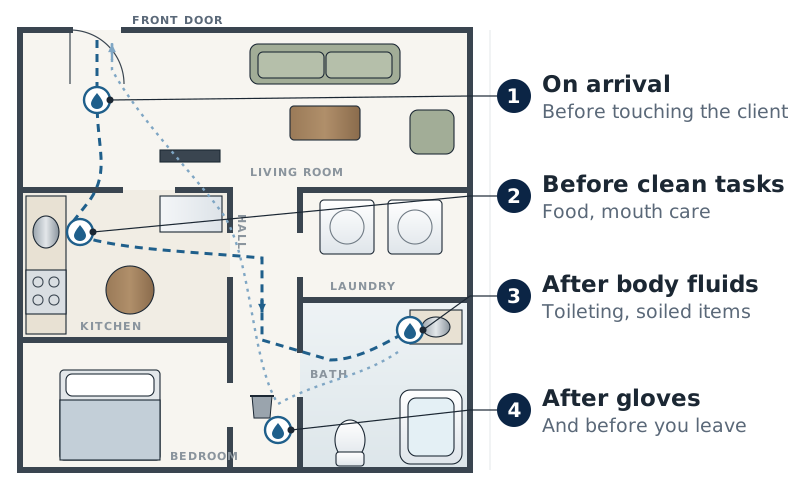
- How germs travel in a home compared with a clinic: shared sinks, towels, pets and moving between bathroom and kitchen in one visit.
- A scenario on a client with a new urinary catheter after a hospital stay and the chain of infection.
- Hand hygiene moments adapted to a home visit, and a norovirus handwashing scenario.
- A sick-before-shift scenario and the CDC return-to-activity and 48-hour norovirus guidance.
- A scenario on an uncapped insulin pen needle found in bed linens.
- A pneumonia scenario with new confusion and no fever, and writing objective visit notes.
- The separate bloodborne pathogens course (29 CFR 1910.1030) is referred to for blood exposure, needlesticks and blood spills, and not repeated here.
What your employer provides
Employers remain responsible for training on their own policies and care plans and for keeping each caregiver's annual training-hour record.
The certificate
Lists your name, the standard, the completion date, the retrain by date, and a verification number with a QR code. Page two lists the training elements covered.
Training staff?
Buy seats, invite people by email, and track completion on a dashboard. Buy seats.